Capital Market Assumptions
Executive Summary
Reading the newspapers and tracking the social media feeds can make it feel like a grave, new world. But despite all the events and noise, markets have been impressively resilient in 2026.
Amid geopolitical events, tech volatility, and hawkish central bankers, it’s been a year of strong, but not stellar, returns for stock markets. The bright spots have been in international and emerging markets. Also, in commodities and in real assets. But the rapid repricing of interest rates has hurt fixed income performance. With the dollar and crypto also underwhelming investors.
So where should medium term investors focus their attention now? Our annual exercise to assess long term capital market assumptions across the universe of public and private markets, attempts to highlight the opportunities for strategic asset allocators. This is an important project; carefully calibrating future returns is probably the most important step to avoid disappointing portfolio performance.
As usual, we do this by building-up asset class specific expected returns. Not based on history, but on the idea that the economic environment, market valuations, and future fundamentals can guide our thinking. Starting with some assumptions for interest rates, we then add-in asset class specific risk premia. The numbers are developed with a clear philosophy of how markets work, which is backed-up by technical research.
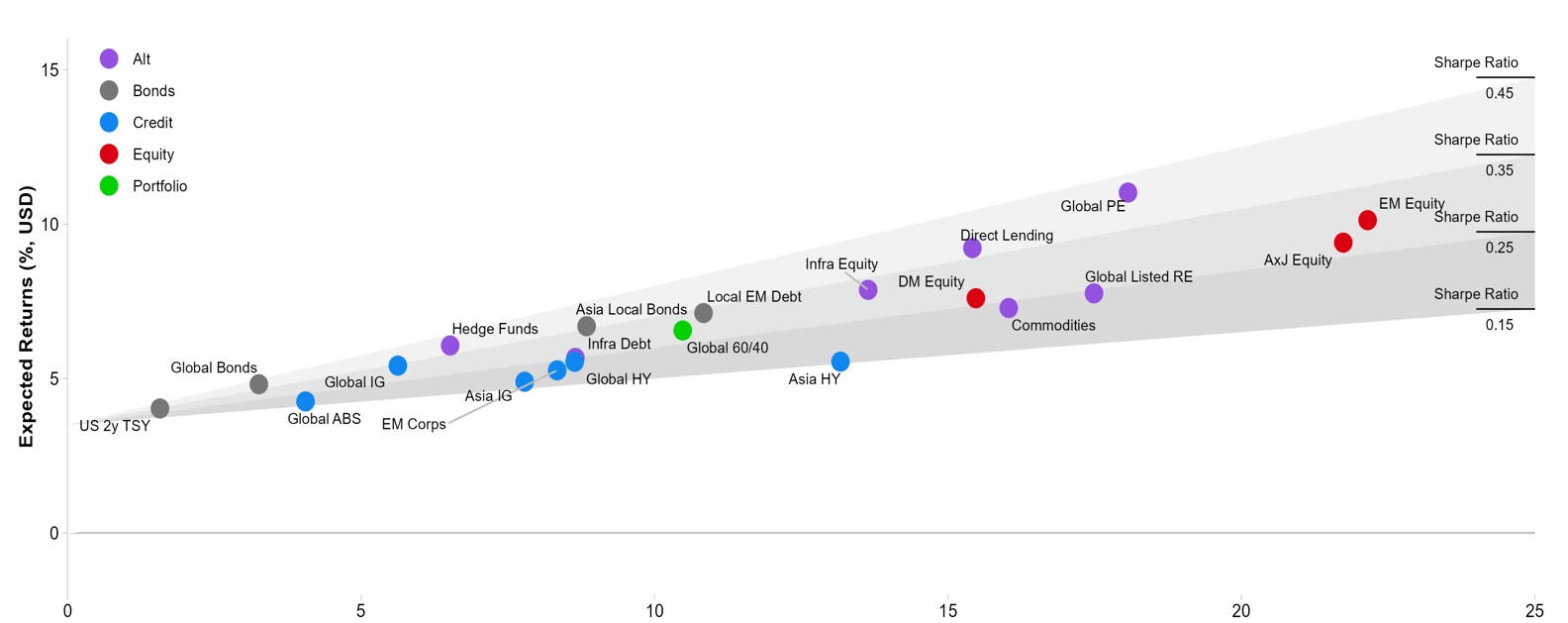
Figure 1 shows today’s pecking order of asset classes; ten-year expected returns scaled by expected volatility. Three key conclusions stand-out.
Figure 1 - HSBC AM capital market line (10 year expected returns for selected assets)
Click the image to enlarge
Source: HSBC Asset Management, as of September 2026. Past performance does not predict future returns. Any forecast, projection or target where provided is indicative only and is not guaranteed in any way. HSBC Asset Management accepts no liability for any failure to meet such forecast, projection or target. The views expressed above were held at the time of preparation and are subject to change without notice.
First, it is a higher-for-longer interest rate environment. The economic regime is nicely summed up by the phrase “shock and a boom”. Geopolitical uncertainties create volatility in commodities, while the AI capex boom adds heat to specific areas of the economy, and drives up the price of compute power. That creates a spikey and higher inflation profile, versus the 2010s.
And it is a world where economists are revising-up their sense of where interest rates settle. According to the IMF, government deficits remain high across the forecast horizon. And the USD 1Trn of capex planned by the US hyperscalers, coupled with a fragmentation of the global order, is shifting the balance between savings and investment. A higher interest rate environment reflects a greater scarcity of capital.
This is boosting-up the expected returns for cash, and for a range of fixed income asset classes. And it’s especially pronounced in short duration, high-quality public and private credits (e.g. securitised credits, working capital solutions).
Second, relative valuations for the stock market are being squeezed. Today, we measure the US equity risk premium at 3.45 per cent. Many investors have raised concerns about both valuations and concentration risk in US stocks. Based on our capital market assumptions, the solution is clear: rotate portfolios into international and emerging markets. Here, valuations are lower, profitability can recover, and future returns are lifted by the prospect of appreciating currencies.
A really stark example is to note that US stocks represent 2/3rds of the global market cap benchmark (with US AI some 25 per cent). But the emerging markets market cap weight is barely in the teens, despite being 45 per cent of global GDP (at market exchange rates, according to the World Bank). The expected returns framework strongly supports a rotation in strategic weights, away from US markets and the US dollar.
Third, a supply shocked economic regime requires us to rethink our understanding of safe assets. Higher expected returns in G7 government bonds follow from the lost equity hedging properties. Stock-bond correlations around zero actually look a lot more normal, from a historic perspective.
We don’t think there is a silver bullet for investors to hedge portfolios today. A new age of uncertainty requires us to “diversify the diversifiers”. That means recognising how credit spreads can remain low, despite debt ratios weighing on government long bonds. Or understanding the progress that major emerging markets have made in reforming their economies, which fosters impressive resilience in their asset markets. And seeing how liquid alternatives – hedge funds, commodities, active FX, quantitative investment strategies – can also play a role of bond substitutes in portfolios and help protect us against bad times.
We hope you find our latest research on long term capital market assumptions interesting. The beauty of our approach is that everything is connected to first principles and fundamentals. Of course, our modelling is rigorous, scientific, and data-intensive. But it is also highly intuitive for professional investors. And that gives us conviction that the conclusions will prove correct over the medium-term.
We would like to give a special thanks to our colleagues for their contribution to this report, particularly Dominic Bryant, Maulshree Saroliya, Karen, Olney, Hussain Mehdi and Miguel Ancona.