

China Insights
Market spotlight: Policy support shifts closer to households
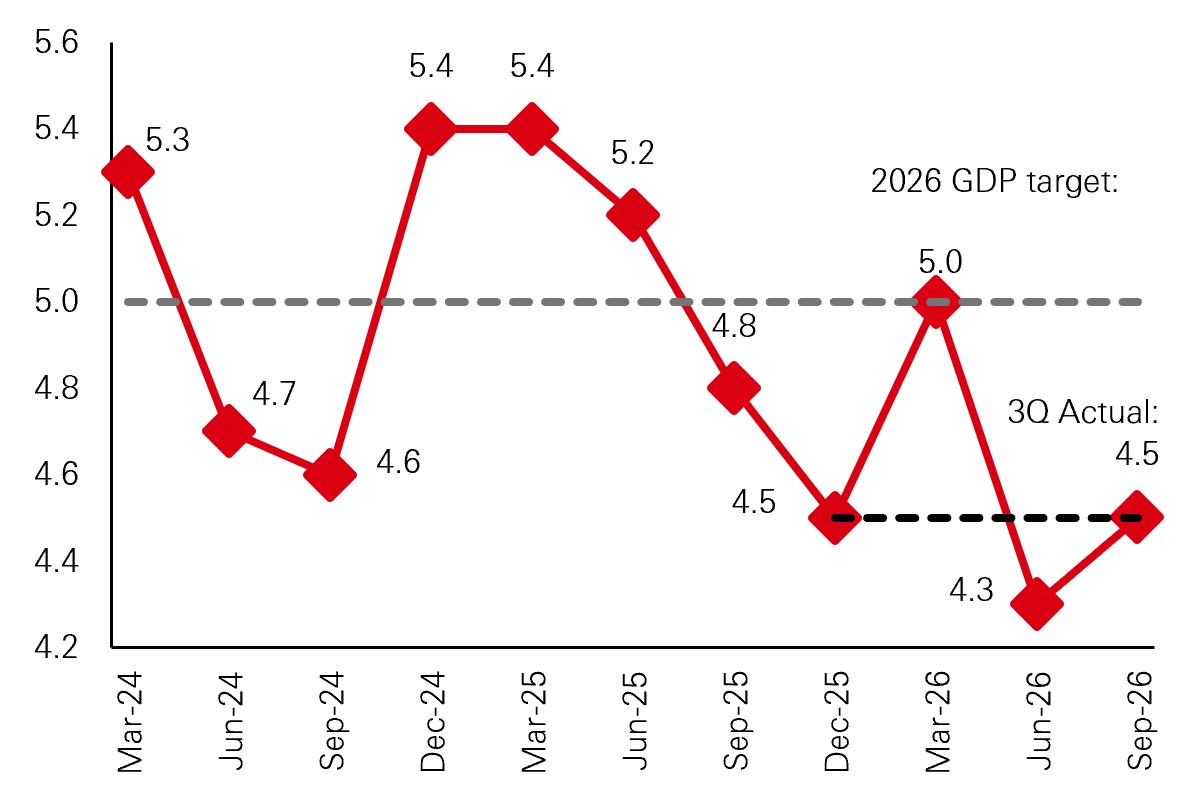
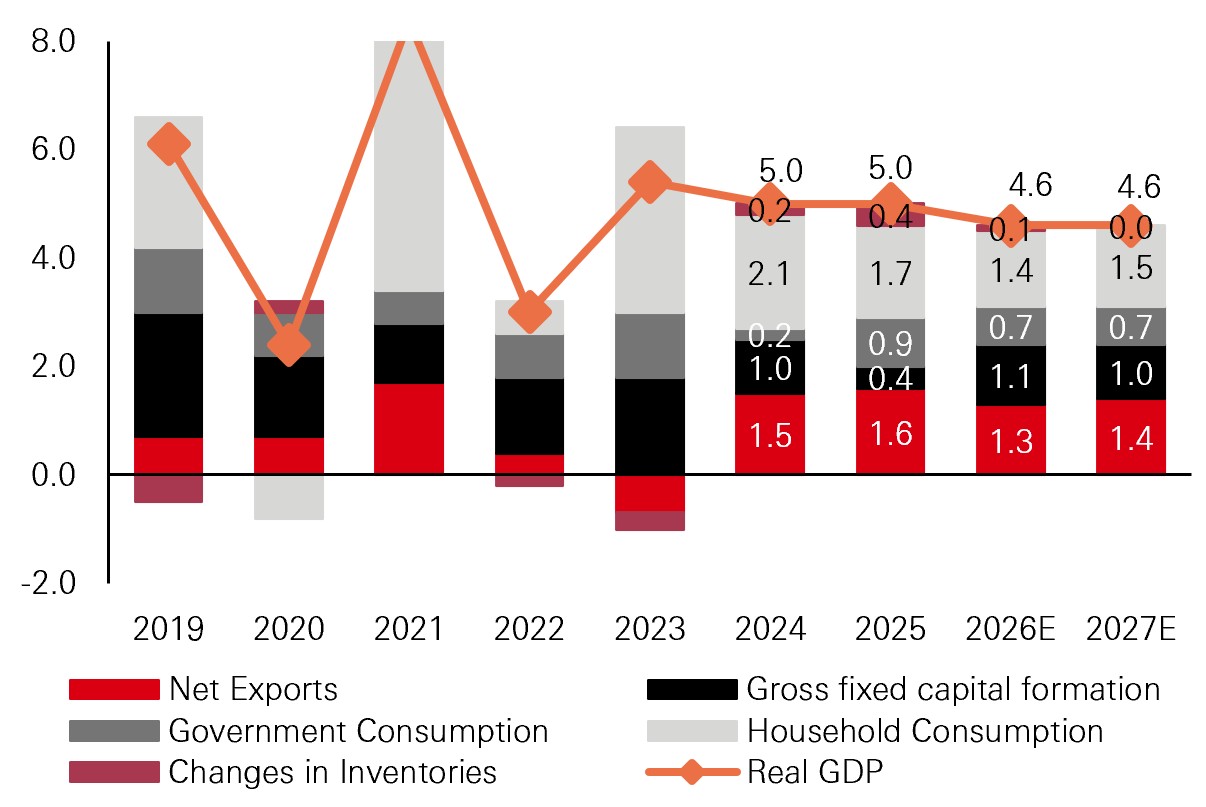
China’s headline growth has stabilised after weakening through the middle of the year, but the underlying picture remains uneven. Manufacturing and exports continue to provide support, while weak domestic demand and the ongoing property adjustment remain a drag. Retail sales are expected to grow by just 1.7 per cent year-on-year in the second half of 2026, suggesting that a strong consumption led reflation remains unlikely in the near term.
Figure 1: China real GDP growth, year-on-year (per cent)
Click the image to enlarge
Figure 2: China real GDP growth by expenditure (per cent)
Click the image to enlarge
Past performance does not predict future returns. Any forecast, projection or target where provided is indicative only and not guaranteed in any way. Source: CEIC, HSBC Asset Management, Morgan Stanley Research estimates, October 2026.
Policy is responding, but in a measured way. In September, the Ministry of Finance announced RMB300 billion of special Treasury bonds to replenish core Tier 1 capital at eight centrally administered financial institutions, including two major state-owned banks. The measure is intended primarily to strengthen loss absorption capacity and preserve future lending flexibility rather than trigger a major new credit cycle. With loan demand still subdued, the immediate growth impulse is likely to remain limited.
More notable is the gradual change in where support is being directed. From October, qualifying first time homebuyers can receive a one percentage point fiscal subsidy on mortgage interest for eligible residential purchases for up to five years, while the government’s new 2026–30 consumption plan targets retail sales of around RMB60 trillion by 2030. These measures remain targeted, but they signal a greater emphasis on reducing household financing costs and supporting consumption rather than relying solely on investment and producer side stimulus.
Property nevertheless remains the clearest constraint. Real estate investment fell 21 per cent year-on-year in the first nine months and new home sales area declined 13 per cent. Yet second hand housing transactions rose 11 per cent and now account for more than half of housing transactions.
The divergence points to a shift in activity towards the existing home market rather than a broad housing recovery, with developer investment and new construction still under considerable pressure.
That is a clear signal that China’s broader economy continues to retain important offsets. Its manufacturing base remains highly competitive, exporters continue to gain share in selected industries and overseas revenues have remained resilient. Improving producer prices also point to some easing in industrial deflation, even as domestic demand remains uneven. The result is a widening gap between sectors exposed to household demand and those benefiting from China’s manufacturing and export competitiveness.
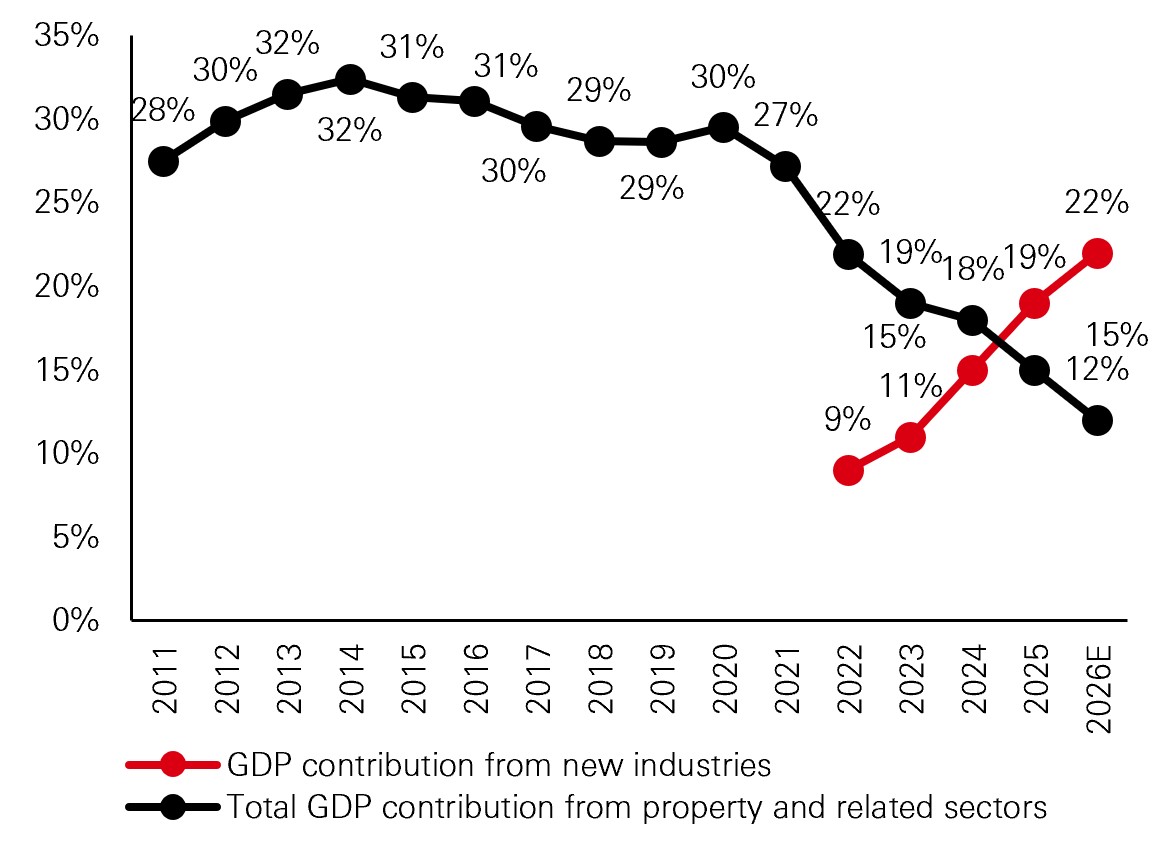
At the same time, the investment mix is changing. Overall fixed asset investment fell 7.2 per cent, while investment in intellectual property products rose 9.3 per cent and information transmission infrastructure increased 31 per cent. China is increasingly redirecting capital away from traditional property-led activity towards digital infrastructure, technology and intangible assets.
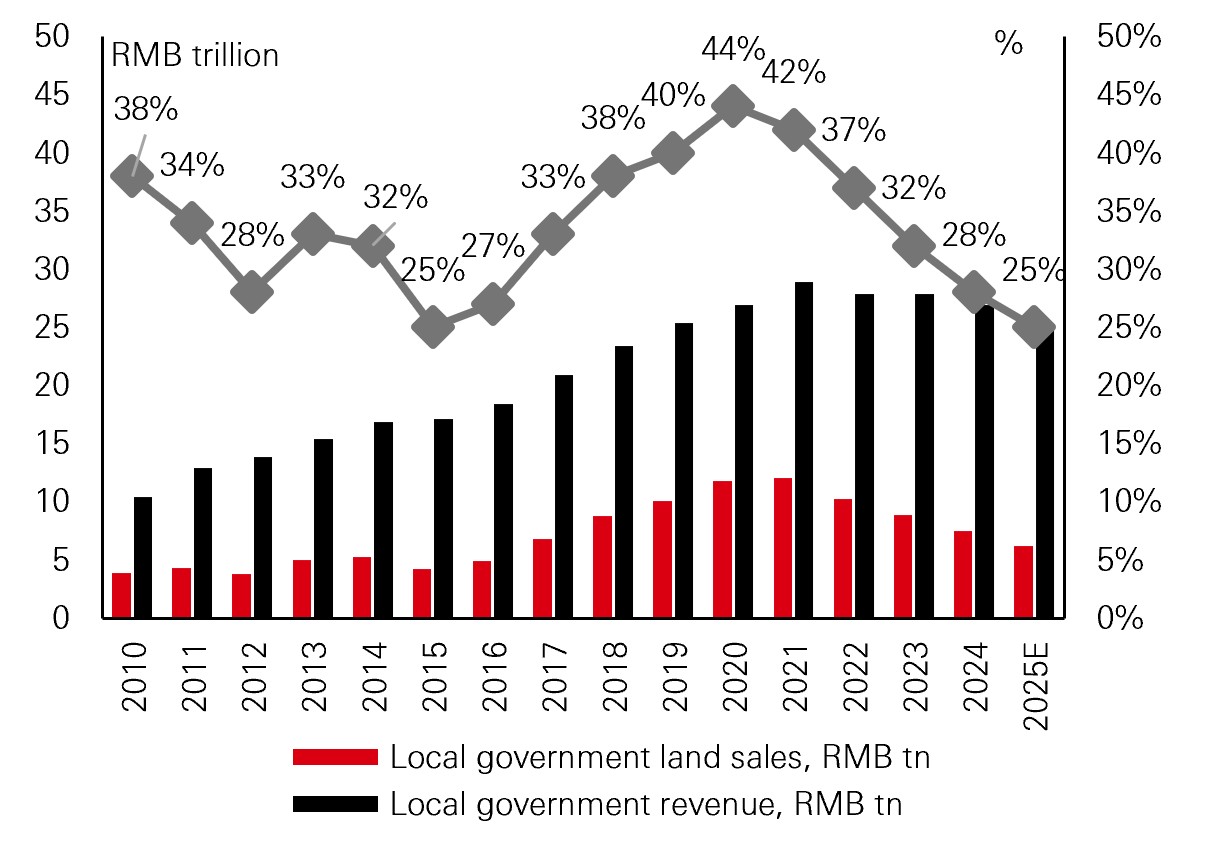
Figure 3: Land sales versus revenue
Click the image to enlarge
Figure 4: GDP contribution from property sector and new industries
Click the image to enlarge
Past performance does not predict future returns. Any forecast, projection or target where provided is indicative only and not guaranteed in any way. Source: Wind, NBS, Citi, HSBC Asset Management estimate, Morgan Stanley Research estimates, MSCI, Factiva, Haver Analytics, Goldman Sachs Global Investment Research, September 2026. Note: New industries include electric vehicles, advanced manufacturing and biotechnology.
The external and financial backdrop adds another source of differentiation. China’s monetary cycle remains relatively independent of the Federal Reserve, supported by subdued inflation and an easing bias. At the same time, a persistent trade and current account surplus has helped support the renminbi, even as domestic interest rates remain well below US levels. Foreign ownership of domestic bonds and equities remains low, limiting direct foreign selling pressure, while Chinese government bond yields have continued to respond more to domestic conditions than to the global rates cycle.
Taken together, this creates a two-speed macro picture. Domestic demand and property remain weak, but manufacturing, exports and a changing investment mix continue to provide support. The key shift is policy moving incrementally closer to households while capital formation is moving further towards technology intensive growth.
China equities
Profit recovery masks widening dispersion
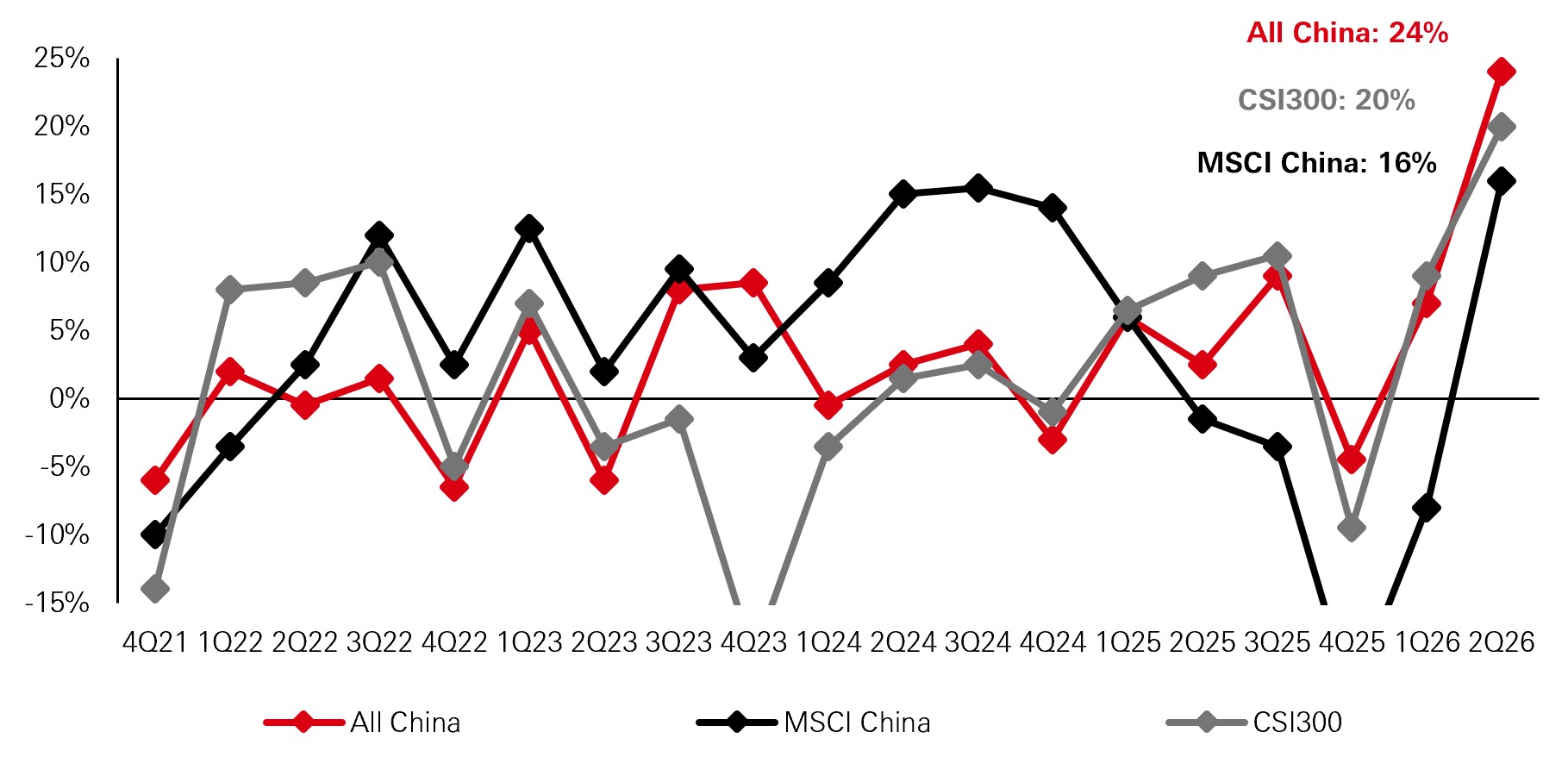
China’s equity story increasingly mirrors the broader economy, characterised by headline improvement, which is far from uniform. All-China earnings growth accelerated to around 24 per cent year-on-year in the second quarter, led by hard technology, financials, materials and energy. Export-oriented companies have been particularly resilient, with overseas revenues up 23 per cent in the first half and exporter earnings rising by around 80 per cent.
Figure 1: Earnings growth, year-on-year (per cent)
Past performance does not predict future returns. Any forecast, projection or target where provided is indicative only and not guaranteed in any way. Source: FactSet, Wind, MSCI, CSI, Goldman Sachs Global Investment Research, HSBC Asset Management, September 2026.
Technology remains central to that recovery. AI-related investment is broadening beyond headline model developers into semiconductors, memory, servers, optical components, data centres, power equipment, cloud and cybersecurity. This creates a wider domestic technology supply chain but also raises concentration risk. Information technology represented around 46 per cent of onshore active mutual fund portfolios in the second quarter, well above its historical norm.
Industrial profit data shows just how wide that dispersion has become. Overall industrial profits rose 16 per cent year-on-year in January through to August, but profits in computers, communications and electronics increased by around 110 per cent, non-ferrous metals by 83 per cent and chemicals by 51 per cent. By contrast, automobile profits fell 16 per cent, electrical machinery declined 5.2 per cent and ferrous-metals profits dropped 62 per cent.
The recovery is therefore substantial, but concentrated, putting greater emphasis on the durability of the underlying earnings drivers. China’s value chain upgrade continues to support areas including semiconductors, industrial technology, robotics, shipbuilding, chemicals, materials and logistics, where overseas demand and rising technological content provide earnings support independent of a broad domestic recovery.
The weaker side of the market remains closely linked to household demand. Property, retail and parts of the consumer complex continue to face subdued pricing power, while offshore internet earnings may only recover gradually as food delivery subsidies narrow and cloud and AI monetisation improve.
The ownership backdrop is changing at the same time. Social security funds, annuities and insurers have bought more than RMB600 billion of A-shares on a net basis this year, lifting the market value of their holdings by 13 per cent from end of 2025. Hong Kong’s primary market has also revived, with 118 new listings in the first nine months and IPO proceeds of HKD388 billion, more than double the same period last year. This creates a different market structure from earlier cycles. Domestic long term capital is becoming more important, even as active foreign investors remain relatively lightly positioned in China.
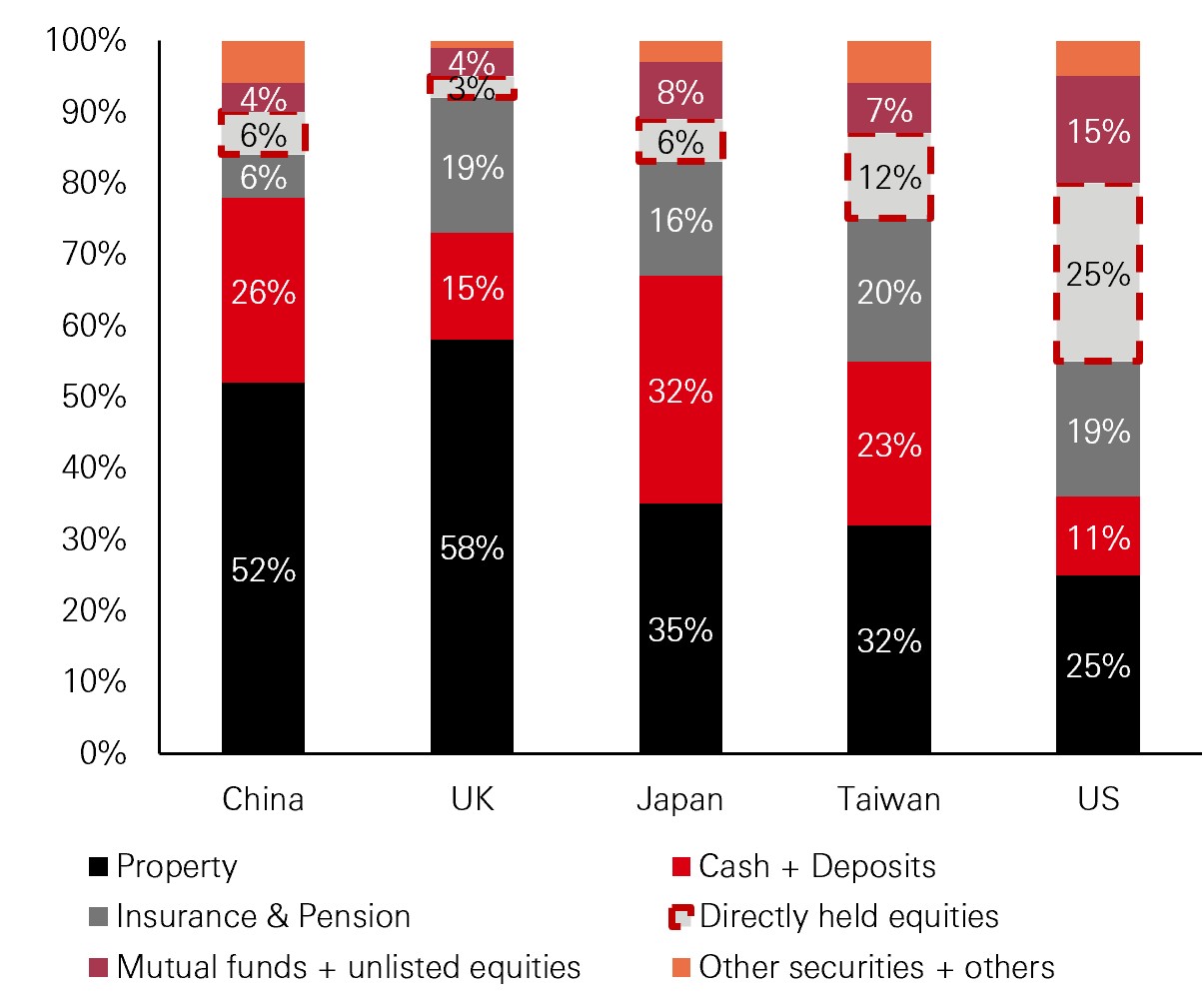
Figure 2: Composition of household total assets
Click the image to enlarge
Source: CEIC, Goldman Sachs Global Investment Research, HSBC Asset Management. Other securities + others: residual of rounded shares. Data as of 31 March 2026.
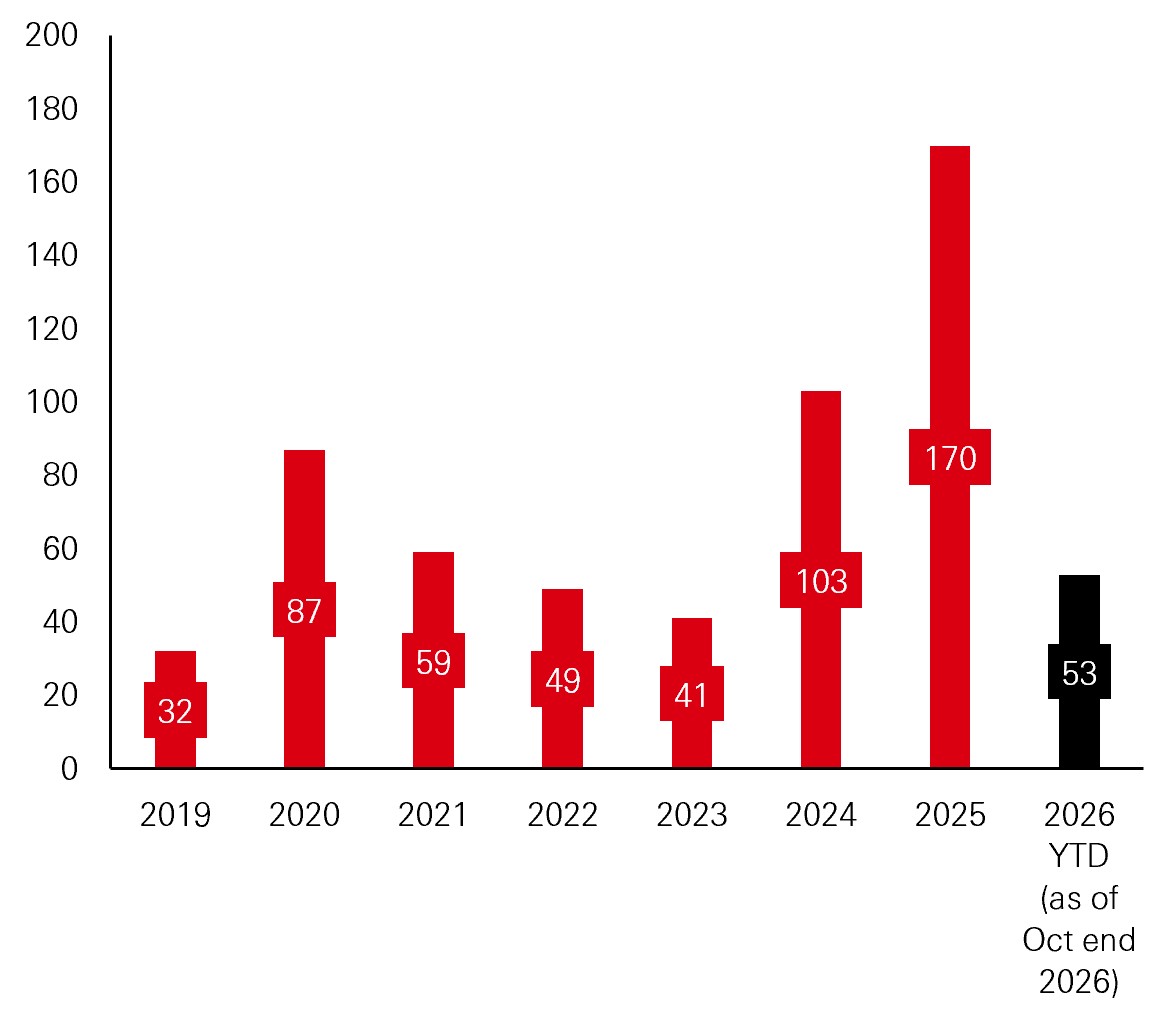
Figure 3: Southbound flows (USD billion)
Click the image to enlarge
Source: Wind, HSBC Asset Management. Data as of October 2026.
Valuations provide some support as China trades at a discount to many global peers, with resilient earnings growth in technology and other structural growth sectors. While earnings revisions remain uneven, the recent valuation reset has improved the risk reward for companies with strong fundamentals and earnings visibility.
China’s equity market is increasingly experiencing dispersion rather than a broad market rerating. Earnings remain strongest where technology, manufacturing and external demand reinforce one another, while domestically exposed sectors still require a more durable improvement in household demand. The changing investor base may provide greater market depth, but the distinction between structural growth and cyclical repair remains central to stock selection.
That same evolution in China’s financial architecture is also visible in fixed income, where policymakers are simultaneously reducing legacy balance sheet pressures and deepening RMB capital markets.
China fixed income
RMB bonds marching to their own beat
China’s fixed income market is once again showing its independence from the global rates cycle. Subdued inflation, an easing monetary bias and relatively low foreign ownership have allowed Chinese bonds to behave differently from US Treasuries and other developed market rates during periods of volatility.
The currency is also contributing to returns for foreign investors in RMB bonds. The offshore renminbi has strengthened by almost 5 per cent against the US dollar this year, despite lower domestic interest rates, supported by resilient exports and China’s external surplus. As a result, the return profile of RMB assets increasingly reflects both bond income and currency movements.
A newer part of that story is the acceleration of local government balance sheet repair. By September, local governments had issued RMB1.90 trillion of special bonds to swap hidden debt, equivalent to 95 per cent of the 2026 annual quota, while 98 per cent of the broader RMB6 trillion debt swap programme had been issued. Replacing higher cost hidden liabilities with more transparent and cheaper government borrowing reduces near term refinancing pressure and interest burdens, freeing some fiscal capacity for other spending.
However, debt substitution is not the same as repairing the underlying revenue base. Government land sale revenues were still down 28 per cent year-on-year in the first nine months, reflecting the continuing effect of the property downturn on local government finances. The distinction is important because the debt swap improves liquidity and maturity profiles, but the longer term health of local balance sheets still depends on rebuilding sustainable revenue sources beyond land sales.
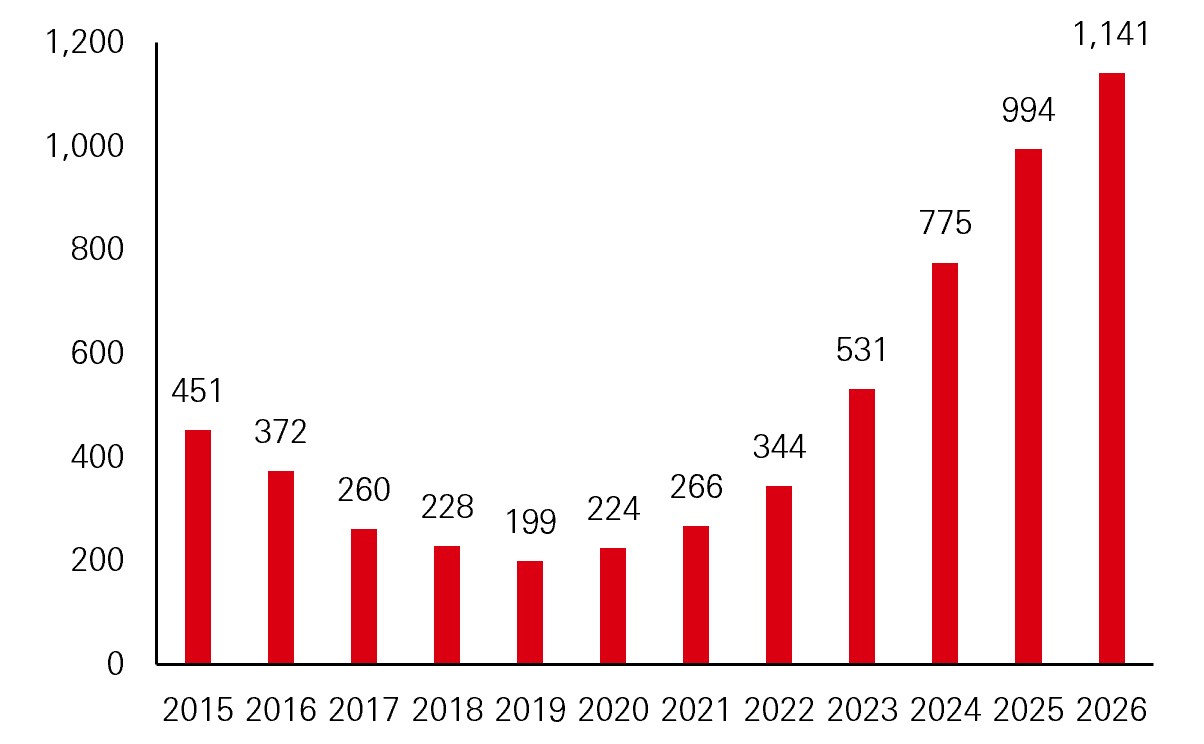
Figure 1: Total CNH credit bonds outstanding (RMB billion)
Click the image to enlarge
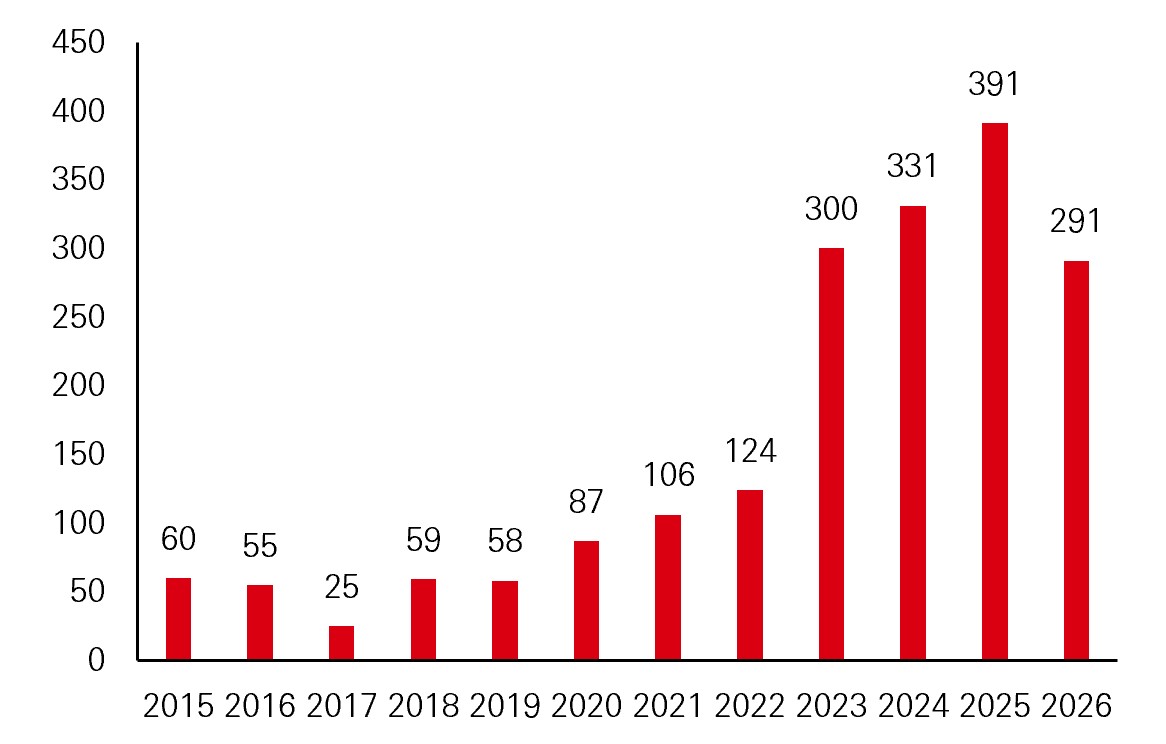
Figure 2: New issuance of CNH credit, 2015 – 2026 YTD (RMB billion)
Click the image to enlarge
Past performance does not predict future returns.
Source: Bloomberg Finance L.P., J.P. Morgan, HSBC Asset Management. Data as of August 2026.
In parallel, the offshore renminbi market is developing quickly. Outstanding CNH credit has more than quadrupled since 2021, from RMB266 billion to around RMB1.14 trillion. New issuance has expanded from less than RMB100 billion in 2020 to nearly RMB400 billion in 2025, with 2026 on track for around RMB500 billion. The expansion is a part of a broader internationalisation process rather than simply a rise in bond issuance. Policy efforts are increasingly focused on deepening offshore RMB liquidity, widening channels of onshore capital to invest abroad and developing additional hedging and derivatives infrastructure.
This expansion is increasingly supported by market infrastructure rather than issuance alone. Southbound Bond Connect and Swap Connect have channelled more onshore liquidity offshore, while the RMB now accounts for roughly 29 per cent of China’s goods trade settlement. That has increased the offshore currency pool across financial centres including Hong Kong, Singapore and London and helped deepen secondary market liquidity.
Institutional participation is also broadening. Mainland investors have continued to record net purchases of offshore debt, while dim-sum issuance has reached roughly RMB830 billion in 2026, more than 30 per cent above last year. As the issuer base expands, the CNH market is gradually moving beyond a predominantly China focused credit market towards a broader regional funding platform.
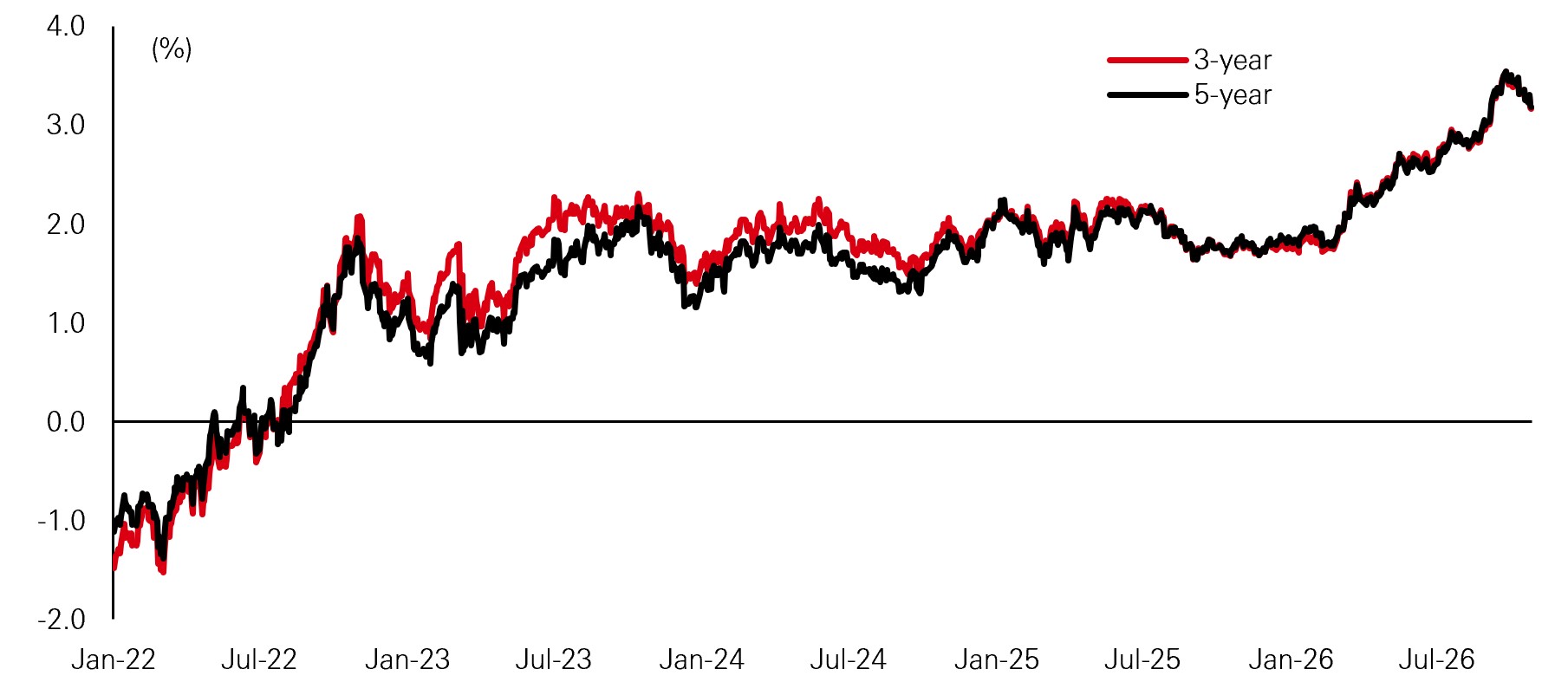
For global investors, the appeal is not primarily the level of nominal yields, which remain below comparable USD markets. The case instead rests on the combination of an independent policy cycle, relatively low correlation with global rates and issuer level relative value and potential currency appreciation. Even when offshore RMB bond yields appear modest in isolation, a firmer renminbi can improve total returns for unhedged investors. Relative value provides an additional dimension. Differences in underlying interest rate environments mean that headline yields do not always provide a directly comparable view of CNH and USD bonds. Translating CNH yields into USD equivalent terms using cross-currency and float-to-fixed swaps provides a more comparable basis for assessing relative value. This can reveal selective opportunities across issuers and maturities versus comparable USD denominated bonds.
Figure 3: CNH bond yields on a USD equivalent basis
Click the image to enlarge
Past performance does not predict future returns. Source: Bloomberg, HSBC Asset Management. Data as of October 2026. Note: USD equivalent yields are calculated by swapping CNH bond yields into USD using cross-currency and float-to-fixed interest rate swaps
China’s fixed income market therefore has two related dimensions. Domestically, debt restructuring is reducing immediate balance sheet stress without removing the underlying fiscal challenge. Offshore, deeper liquidity, a broader issuer base and greater use of the renminbi in trade and capital markets are increasing its relevance as both a funding currency and an investment market. Together, this adds a currency dimension to the diversification and relative value case already offered by RMB fixed income.
Source: HSBC Asset Management, November 2026 Past performance does not predict future returns. For informational purposes only and should not be construed as a recommendation to invest in the specific country, product, strategy, sector or security. The views expressed above were held at the time of preparation and are subject to change without notice. Any forecast, projection or target where provided is indicative only and not guaranteed in any way. HSBC Asset Management accepts no liability for any failure to meet such forecast, projection or target.
Important information
For Professional Clients and intermediaries within countries and territories set out below; and for Institutional Investors and Financial Advisors in the US. This document should not be distributed to or relied upon by Retail clients/investors.
The value of investments and the income from them can go down as well as up and investors may not get back the amount originally invested. The performance figures contained in this document relate to past performance, which should not be seen as an indication of future returns. Future returns will depend, inter alia, on market conditions, investment manager’s skill, risk level and fees. Where overseas investments are held the rate of currency exchange may cause the value of such investments to go down as well as up. Investments in emerging markets are by their nature higher risk and potentially more volatile than those inherent in some established markets. Economies in emerging markets generally are heavily dependent upon international trade and, accordingly, have been and may continue to be affected adversely by trade barriers, exchange controls, managed adjustments in relative currency values and other protectionist measures imposed or negotiated by the countries and territories with which they trade. These economies also have been and may continue to be affected adversely by economic conditions in the countries and territories in which they trade.
The contents of this document may not be reproduced or further distributed to any person or entity, whether in whole or in part, for any purpose. All non-authorised reproduction or use of this document will be the responsibility of the user and may lead to legal proceedings. The material contained in this document is for general information purposes only and does not constitute advice or a recommendation to buy or sell investments. Some of the statements contained in this document may be considered forward looking statements which provide current expectations or forecasts of future events. Such forward looking statements are not guarantees of future performance or events and involve risks and uncertainties. Actual results may differ materially from those described in such forward-looking statements as a result of various factors. We do not undertake any obligation to update the forward-looking statements contained herein, or to update the reasons why actual results could differ from those projected in the forward-looking statements. This document has no contractual value and is not by any means intended as a solicitation, nor a recommendation for the purchase or sale of any financial instrument in any jurisdiction in which such an offer is not lawful. The views and opinions expressed herein are those of HSBC Asset Management at the time of preparation and are subject to change at any time. These views may not necessarily indicate current portfolios' composition. Individual portfolios managed by HSBC Asset Management primarily reflect individual clients' objectives, risk preferences, time horizon, and market liquidity. Foreign and emerging markets: investments in foreign markets involve risks such as currency rate fluctuations, potential differences in accounting and taxation policies, as well as possible political, economic, and market risks. These risks are heightened for investments in emerging markets which are also subject to greater illiquidity and volatility than developed foreign markets. This commentary is for information purposes only. It is a marketing communication and does not constitute investment advice or a recommendation to any reader of this content to buy or sell investments nor should it be regarded as investment research. It has not been prepared in accordance with legal requirements designed to promote the independence of investment research and is not subject to any prohibition on dealing ahead of its dissemination. This document is not contractually binding nor are we required to provide this to you by any legislative provision.
All data from HSBC Asset Management unless otherwise specified. Any third-party information has been obtained from sources we believe to be reliable, but which we have not independently verified.
HSBC Asset Management is the brand name for the asset management business of HSBC Group, which includes the investment activities that may be provided through our local regulated entities. HSBC Asset Management is a group of companies in many countries and territories throughout the world that are engaged in investment advisory and fund management activities, which are ultimately owned by HSBC Holdings Plc. (HSBC Group).
- In Australia, this document is issued by HSBC Bank Australia Limited ABN 48 006 434 162, AFSL 232595, for HSBC Global Asset Management (Hong Kong) Limited ARBN 132 834 149 and HSBC Global Asset Management (UK) Limited ARBN 633 929 718. This document is for institutional investors only and is not available for distribution to retail clients (as defined under the Corporations Act). HSBC Global Asset Management (Hong Kong) Limited and HSBC Global Asset Management (UK) Limited are exempt from the requirement to hold an Australian financial services license under the Corporations Act in respect of the financial services they provide. HSBC Global Asset Management (Hong Kong) Limited is regulated by the Securities and Futures Commission of Hong Kong under the Hong Kong laws, which differ from Australian laws. HSBC Global Asset Management (UK) Limited is regulated by the Financial Conduct Authority of the United Kingdom and, for the avoidance of doubt, includes the Financial Services Authority of the United Kingdom as it was previously known before 1 April 2013, under the laws of the United Kingdom, which differ from Australian laws;
- In Bermuda, this document is issued by HSBC Global Asset Management (Bermuda) Limited, of 37 Front Street, Hamilton, Bermuda which is licensed to conduct investment business by the Bermuda Monetary Authority;
- In France, Belgium, Netherlands, Luxembourg, Portugal, Greece, Finland, Norway, Denmark, Spain and Sweden this document is issued by HSBC Global Asset Management (France), a Portfolio Management Company authorised by the French regulatory authority AMF (no. GP99026);
- In Germany, this document is issued by HSBC Global Asset Management (Deutschland) GmbH which is regulated by BaFin (German clients) respective by the Austrian Financial Market Supervision FMA (Austrian clients);
- In Hong Kong, this document is issued by HSBC Global Asset Management (Hong Kong) Limited, which is regulated by the Securities and Futures Commission. This content has not been reviewed by the Securities and Futures Commission;
- In India, this document is issued by HSBC Asset Management (India) Pvt Ltd. which is regulated by the Securities and Exchange Board of India;
- In Italy, this document is issued by HSBC Global Asset Management (France), a Portfolio Management Company authorised by the French regulatory authority AMF (no. GP99026), through its Italian branch, regulated by Banca d’Italia and Commissione Nazionale per le Società e la Borsa (Consob);
- In Japan, this document is issued by HSBC Asset Management (Japan) Ltd (JRN 3010001124868), regulated by the Financial Services Agency;
- In Malta, this document is issued by HSBC Global Asset Management (Malta) Limited which is regulated and licensed to conduct Investment Services by the Malta Financial Services Authority under the Investment Services Act;
- In Mexico, this document is issued by HSBC Global Asset Management (Mexico), SA de CV, Sociedad Operadora de Fondos de Inversión, Grupo Financiero HSBC which is regulated by Comisión Nacional Bancaria y de Valores;
- In the United Arab Emirates, this document is issued by HSBC Investment Funds (Luxembourg) S.A. – Dubai Branch (Level 20, HSBC Tower, PO Box 66, Downtown Dubai, United Arab Emirates) regulated by the Capital Market Authority (CMA) in the UAE to conduct investment fund management, portfolios management, fund administration activities (CMA Category 2 license No.20200000336) and promotion activities (CMA Category 5 license No.20200000327).
- In the United Arab Emirates, this document is issued by HSBC Global Asset Management MENA, a unit within HSBC Bank Middle East Limited, U.A.E Branch, PO Box 66 Dubai, UAE, regulated by the Central Bank of the U.A.E. and the Capital Market Authority in the UAE under CMA license number 602004 for the purpose of this promotion and lead regulated by the Dubai Financial Services Authority. HSBC Bank Middle East Limited is a member of the HSBC Group and HSBC Global Asset Management MENA are marketing the relevant product only in a sub-distributing capacity on a principal-to-principal basis. HSBC Global Asset Management MENA may not be licensed under the laws of the recipient’s country of residence and therefore may not be subject to supervision of the local regulator in the recipient’s country of residence. One of more of the products and services of the manufacturer may not have been approved by or registered with the local regulator and the assets may be booked outside of the recipient’s country of residence.
- In Singapore, this document is issued by HSBC Global Asset Management (Singapore) Limited, which is regulated by the Monetary Authority of Singapore. The content in the document/video has not been reviewed by the Monetary Authority of Singapore;
- In Switzerland, this document is issued by HSBC Global Asset Management (Switzerland) AG. This document is intended for professional investor use only. For opting in and opting out according to FinSA, please refer to our website; if you wish to change your client categorization, please inform us. HSBC Global Asset Management (Switzerland) AG having its registered office at Gartenstrasse 26, PO Box, CH-8002 Zurich has a licence as an asset manager of collective investment schemes and as a representative of foreign collective investment schemes. Disputes regarding legal claims between the Client and HSBC Global Asset Management (Switzerland) AG can be settled by an ombudsman in mediation proceedings. HSBC Global Asset Management (Switzerland) AG is affiliated to the ombudsman FINOS having its registered address at Talstrasse 20, 8001 Zurich. There are general risks associated with financial instruments, please refer to the Swiss Banking Association (“SBA”) Brochure “Risks Involved in Trading in Financial Instruments”;
- In Taiwan, this document is issued by HSBC Global Asset Management (Taiwan) Limited which is regulated by the Financial Supervisory Commission R.O.C. (Taiwan);
- In Turkiye, this document is issued by HSBC Asset Management A.S. Turkiye (AMTU) which is regulated by Capital Markets Board of Turkiye. Any information here is not intended to distribute in any jurisdiction where AMTU does not have a right to. Any views here should not be perceived as investment advice, product/service offer and/or promise of income. Information given here might not be suitable for all investors and investors should be giving their own independent decisions. The investment information, comments and advice given herein are not part of investment advice activity. Investment advice services are provided by authorized institutions to persons and entities privately by considering their risk and return preferences, whereas the comments and advice included herein are of a general nature. Therefore, they may not fit your financial situation and risk and return preferences. For this reason, making an investment decision only by relying on the information given herein may not give rise to results that fit your expectations.
- In the UK, this document is issued by HSBC Global Asset Management (UK) Limited, which is authorised and regulated by the Financial Conduct Authority;
- In the US, this document is issued by HSBC Securities (USA) Inc., an HSBC broker dealer registered in the US with the Securities and Exchange Commission under the Securities Exchange Act of 1934. HSBC Securities (USA) Inc. is also a member of NYSE/FINRA/SIPC. HSBC Securities (USA) Inc. is not authorized by or registered with any other non-US regulatory authority. The contents of this document are confidential and may not be reproduced or further distributed to any person or entity, whether in whole or in part, for any purpose without prior written permission.
- In Chile, operations by HSBC's headquarters or other offices of this bank located abroad are not subject to Chilean inspections or regulations and are not covered by warranty of the Chilean state. Obtain information about the state guarantee to deposits at your bank or on www.cmfchile.cl;
- In Colombia, HSBC Bank USA NA has an authorized representative by the Superintendencia Financiera de Colombia (SFC) whereby its activities conform to the General Legal Financial System. SFC has not reviewed the information provided to the investor. This document is for the exclusive use of institutional investors in Colombia and is not for public distribution;
- In Costa Rica, the Fund and any other products or services referenced in this document are not registered with the Superintendencia General de Valores (“SUGEVAL”) and no regulator or government authority has reviewed this document, or the merits of the products and services referenced herein. This document is directed at and intended for institutional investors only.
- In Peru, HSBC Bank USA NA has an authorized representative by the Superintendencia de Banca y Seguros in Perú whereby its activities conform to the General Legal Financial System - Law No. 26702. Funds have not been registered before the Superintendencia del Mercado de Valores (SMV) and are being placed by means of a private offer. SMV has not reviewed the information provided to the investor. This document is for the exclusive use of institutional investors in Perú and is not for public distribution;
- In Uruguay, operations by HSBC's headquarters or other offices of this bank located abroad are not subject to Uruguayan inspections or regulations and are not covered by warranty of the Uruguayan state. Further information may be obtained about the state guarantee to deposits at your bank or on www.bcu.gub.uy.
Copyright © HSBC Global Asset Management Limited 2026. All rights reserved. No part of this publication may be reproduced, stored in a retrieval system, or transmitted, on any form or by any means, electronic, mechanical, photocopying, recording, or otherwise, without the prior written permission of HSBC Asset Management.
Content ID: D082846_V1.0; Expiry Date: 31.10.2027