

Europe Insights
Market spotlight: The world’s holiday destination
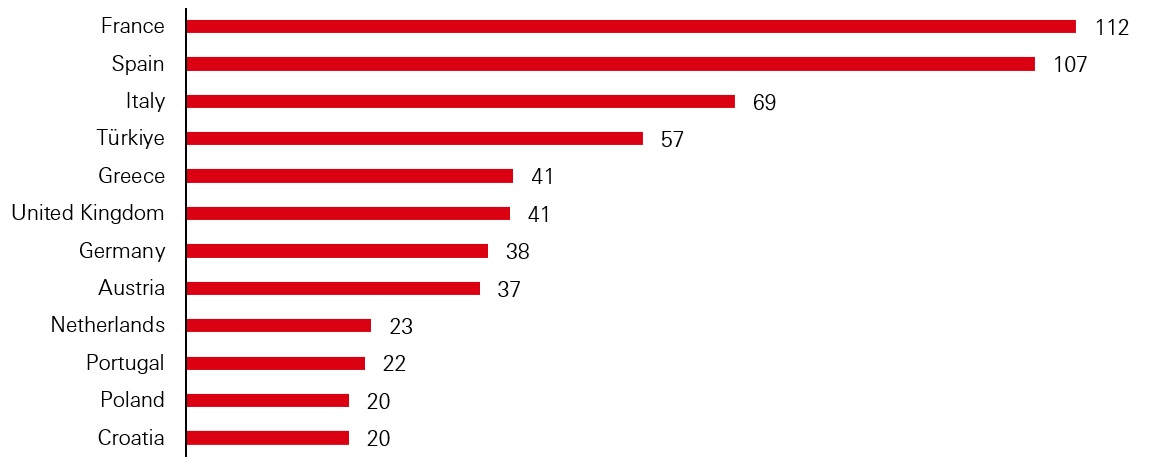
The summer holiday months are often a time reserved for relaxation, a break from the hustle and bustle of everyday life. For Europe, however, summer is one of the busiest periods as tourists flock to taste the culture the continent has to offer. This appeal extends beyond the summer season: Europe1 attracts roughly 50 per cent of worldwide travellers2. Its combination of dense tourism infrastructure, easy cross‑border travel, history, monuments, food, and beautiful, diverse landscapes appeals to travellers with various budgets and interests.
Figure 1: Top European destinations in 2026 based on overnight visitors (millions)
Click the image to enlarge
Source: World Travel & Tourism Council Dashboard https://researchhub.wttc.org/dv-dashboard. Data as of August 2026 (2026 projections as of April 2026)
Demand for European tourism is resilient
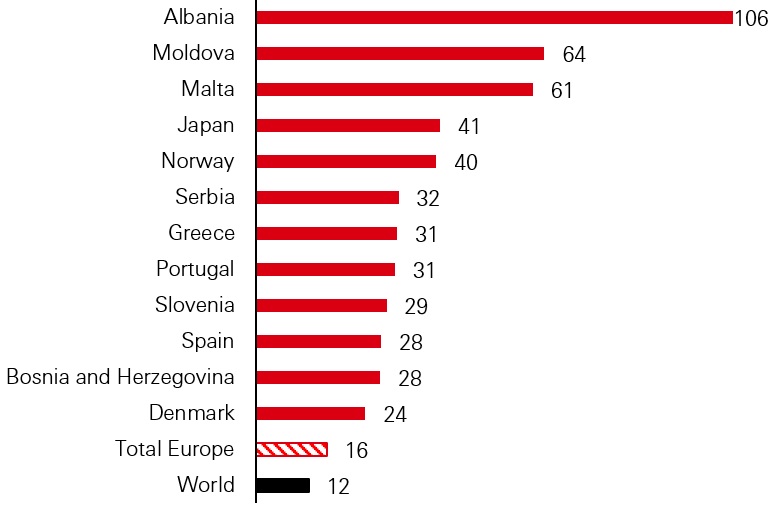
Demand for European tourism has held firm despite recent headwinds from sharp rises in energy costs and aviation travel disruptions. Between 2019 and 2026, performance has been broad-based: two thirds of the European destinations saw visitor growth above the global average. Since 2019, overnight visitors are estimated to have increased by 16 per cent in Europe1, with strong dynamics, notably in the Mediterranean and the small Central and Eastern countries (figure 2).
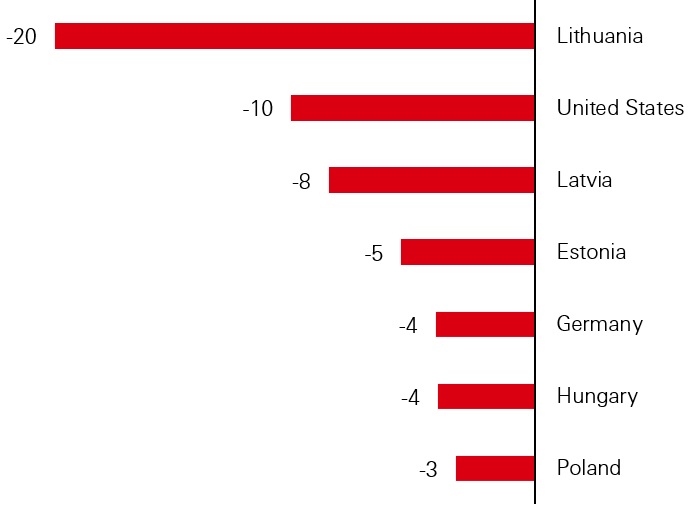
As the broader macro environment weighs on consumer confidence, travellers are now prioritising destinations perceived as safe and offering value for money3. They favour countries with easier border controls or limited foreign policy headwinds. Since 2019, some destinations have lost foreign visitors, like the US4 or those close to regions with geopolitical tensions (Ukraine-Russia, Middle East) including some Eastern European countries, Türkiye and even Germany (figure 3).
Figure 2: Growing momentum destinations over 2019-2026 based on overnight visitors (per cent variation)
Click the image to enlarge
Figure 3: Declining momentum destinations over 2019-2026 based on overnight visitors (per cent variation)
Click the image to enlarge
Source: Refinitiv, HSBC Asset Management. Data as of 12 February 2026
However, on the whole, Europe has strong conditions to attract travellers across a wide range of budgets and experiences. Monaco is eight time more expensive than North Macedonia, the cheapest destination in Europe. Cost-cutting policies in the aviation sector have made Slovakia increasingly attractive, with rising visitors, notably from neighbouring Italy. Alternatively, various tax hikes (Austria and Netherlands) or currency appreciation (Iceland) tend to have slowed the flow of visitors since the beginning of 2026.
Connectivity matters
Another issue travellers have faced is the disruption to air travel, particularly since April as the Middle East conflict intensified. These disruptions continue to push tourists towards more reliable alternatives to flying and rewarding destinations with strong access and flexible routes. Europe possesses extensive rail and road networks which make travelling the continent straightforward, without the need for flying. The Schengen area also allows visa-free travel across many countries. Major hubs like Paris, Brussels, Amsterdam, Frankfurt or Madrid have strong inbound capacity and connections, reinforcing Europe’s role as a global travel anchor.
Growth outside core tourism hubs
Despite the resilience in European travel, many of its popular destinations in Italy, Spain and Greece have not been insulated from broad price increases. However, smaller countries such as Albania, Bosnia and Herzegovina, Moldova, and Malta, are benefitting from record inflows of visitors, as tourists search for cheaper alternatives. These small countries have in turn improved transport infrastructure and connectivity. Malta has particularly benefited from its positioning as a reliable alternative to more saturated destinations, supported by its Mediterranean climate and widespread use of English.
Travel agencies and local players have developed new offerings, such as discovery destinations and travel experiences, such as wine cellars, agritourism or adventure tourism. Another such experience is ‘coolcations’: holidays deliberately chosen for milder temperatures, such as coastal North Sea areas, mountain regions or off-season Mediterranean trips. Northern European (Norway, Denmark, Sweden) or mountain destinations (Austria, Slovenia) have benefitted from this trend and attracted a growing number of visitors since 2019.
Europe has the potential to further leverage value from tourism
International tourism is important for Europe, especially as long-haul travellers usually spend more per trip, but domestic tourism is a potential growth area. For comparison, US residents generate nearly 90 per cent of the country’s tourism & travel sector’s value, compared to 65 per cent on average for Europeans5.
Domestic tourism has several advantages: it provides a stable customer base; it is less affected by exchange rates, border controls or geopolitical crisis; and it is more likely to benefit to secondary cities and rural areas. Additionally, short-distance trips reduce carbon footprint of tourism.
To leverage further value, investment in infrastructure is certainly key, but also investment in people. This includes extending access to training in languages, hospitality, communication and marketing skills. Harmonising qualifications and improving mutual recognition of the various training systems across Europe could provide a useful step in this respect.
Conclusion
Europe remains the world’s leading tourism destination, supported by dense transport networks, cultural diversity and a growing range of tailored travel experiences. While price pressures and geopolitical risks are reshaping visitor flows, they are also opening opportunities for emerging destinations and ‘coolcation’ locations across the continent. By enhancing package offerings, investing in skills and language training, and leveraging digital tools, European tourism players can capture a greater share of visitor spending and reinforce the region’s position as a resilient, high‑value travel hub. For investors and businesses exposed to the European tourist sector, these dynamics highlight both the resilience of demand and the potential to improve value capture through connectivity, product innovation and skills.
1 - Europe includes the European Union in addition to the United Kingdom, Norway, Switzerland, Türkiye, Albania, Montenegro, Serbia, Moldova, Bosnia and Herzegovina, Iceland.
2 - In this report travellers are defined as overnight visitors who stay at least one night in the place they are visiting. Business-oriented trips account for around 10 per cent of the total world trips (United Nations database).
3 - The European Travel Commission Barometer on travel intentions for the May–August 2026 period highlighted, among others, evolving travel patterns with increased budget awareness - ETC Barometer June 2026 - Long-Haul Travel Barometer 2/2026 - June 2026.
4 - Europe is often cheaper compared to the US including in accommodation, transport, food and attractions. Compared to the US, the cost of living is lower in most major European countries, from around -35 per cent in the Mediterranean destinations to -8 per cent in the UK. Source WorldData.Info Cost of living index (2025).
5 - World Travel & Tourism Council Dashboard - Data as of June 2026 (2026 projections as of April 2026).
For informational purposes only and should not be construed as a recommendation to invest in the specific country, product, strategy, sector or security. The views expressed above were held at the time of preparation and are subject to change without notice. Any forecast, projection or target where provided is indicative only and not guaranteed in any way. HSBC Asset Management accepts no liability for any failure to meet such forecast, projection or target.
European equities
AI and beyond
Europe may be better known for its tourism and cultural appeal than for cutting-edge technology, but its listed companies tell a different story. European businesses are embedded in the plumbing of AI, and the market’s relative distance from the frothiest parts of the theme make it a useful diversifier if leadership broadens or sentiment turns.
While most attention centres on a small group of American hyperscalers, semiconductor firms and AI platforms, the technology ultimately relies on heavy infrastructure: large data centres and the equipment that builds and runs them. That means power connections, cooling systems, specialised machinery, precision components and extensive copper wiring. Europe is home to many of the companies supplying these physical inputs. They are rarely household names but are often critical suppliers. As AI adoption accelerates, capital spending on equipment, power and infrastructure should rise – and Europe is well positioned to participate.
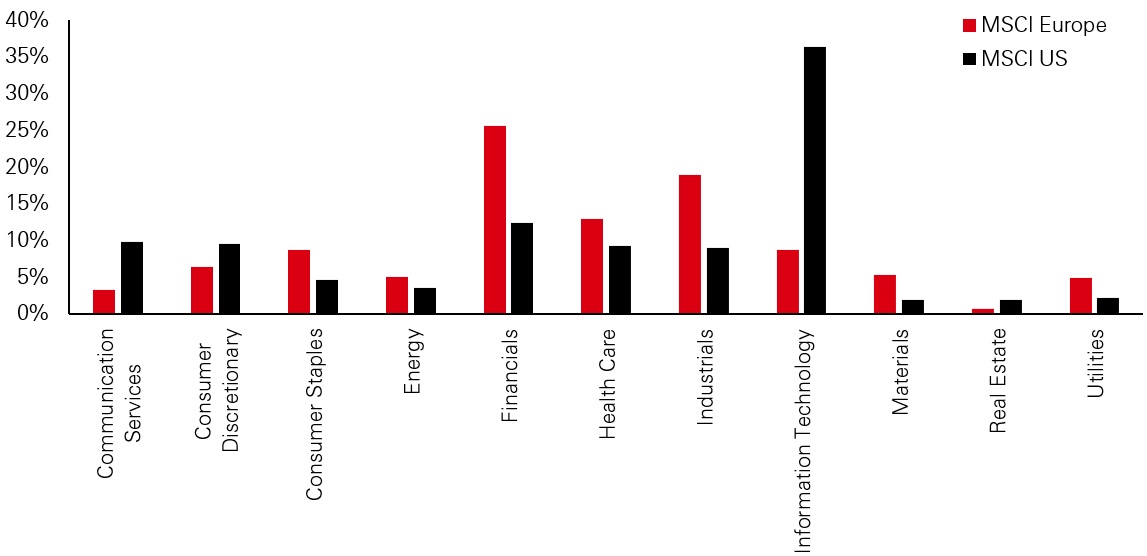
However, the European equity story goes beyond AI. Unlike markets dominated by a narrow set of industries, Europe spans industrials, financials, healthcare, consumer brands, energy and utilities, and a wide range of technology related suppliers. This diversification is a structural advantage that is often under appreciated.
Figure 1: Europe versus US equity sector weights
Click the image to enlarge
Source: MSCI, HSBC Asset Management. Data as of 31 July 2026
Diversification is also found in where European companies generate revenue. They are strikingly global in their revenue mix: only around 45 per cent of sales are generated within developed Europe, and just 22 per cent in home markets. A substantial share of earnings comes from the US and Asia. For investors, that means European equities can provide diversified global exposure while still being valued and traded in European markets.
Recent corporate results are consistent with this picture of resilience. The latest Q2 earnings season was stronger than expected: 31 per cent of companies beat forecasts, and estimates were revised upwards thereafter, with a net 10 per cent balance of upgrades over downgrades. Over time, these upgrades can shift investor perceptions and support a re‑rating of the market.
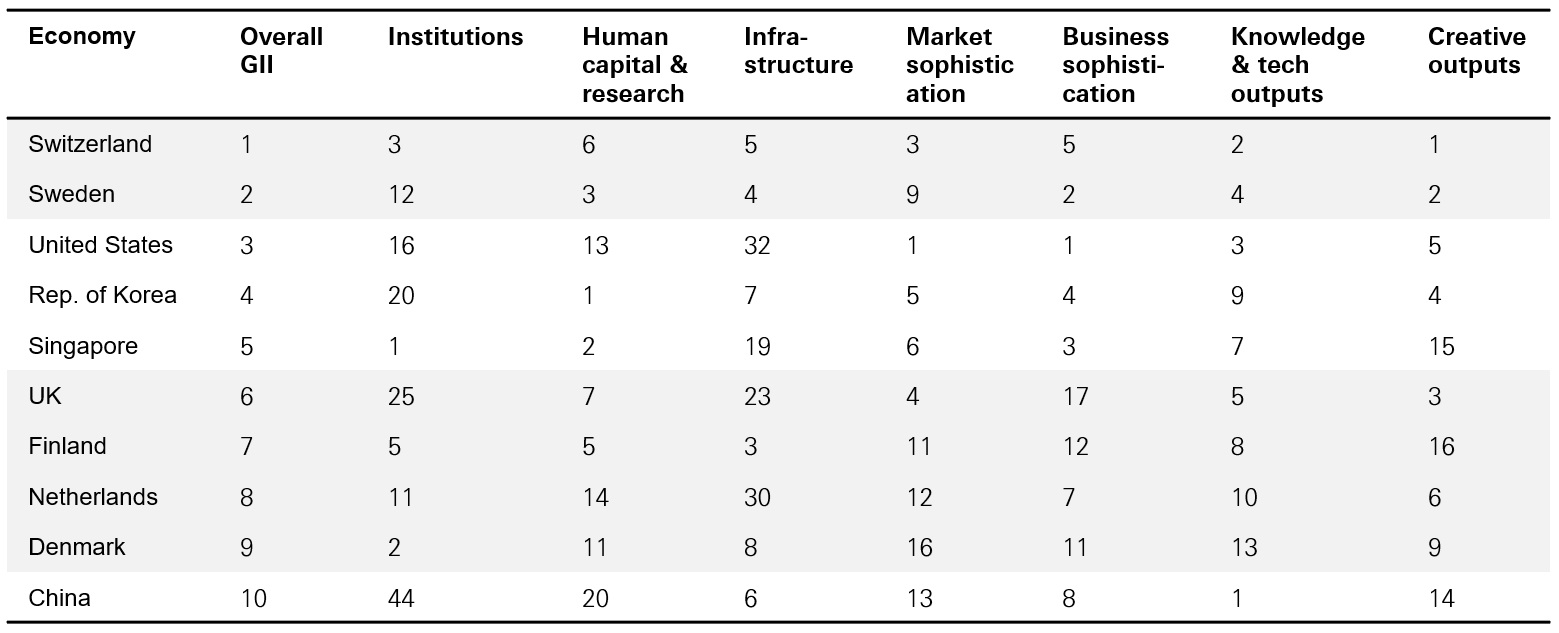
Alongside this, remains at the forefront of innovation, even if it produces fewer giants than the US. By breadth of top performers, Europe is the leading region globally, with 12 economies in the Global Innovation Index top 20 in 2025, including six in the top ten. It also hosts numerous innovation clusters – Germany with seven, the UK with four – supporting strengths in applied engineering, research and specialist supply chains.
Figure 2: Global Innovation Index 2025 rankings overall and by innovation pillar
Click the image to enlarge
Source: Global Innovation Index 2025, Innovation at a Crossroads.
Like any equity market, Europe is not without risk. Energy prices could spike again. Political tensions, both within and beyond the region, could weigh on trade and confidence. A sharp global slowdown would inevitably hurt European firms, given their international reach.
Even so, the balance of the story has shifted. Europe is tangibly benefiting from the build‑out of AI infrastructure. Its listed companies offer broad sector diversification and global revenue exposure, with a substantial share of earnings generated outside home markets. Recent results have been better than feared, with upgrades outpacing downgrades, while valuations remain low relative to many other major markets. Set against this, Europe’s wide and technically sophisticated innovation base adds a further layer of support for future growth.
European fixed income
Financing Europe’s next phase
Europe’s ability to turn its strength into sustained growth will increasingly depend on how effectively investment is financed across the region. Financial integration has therefore moved to the centre of Europe’s long term competitiveness agenda. Through initiatives such as the Savings and Investments Union (SIU), efforts to revive the European securitisation market and the broader Capital Markets Union (CMU), policymakers are seeking to create more integrated capital markets.
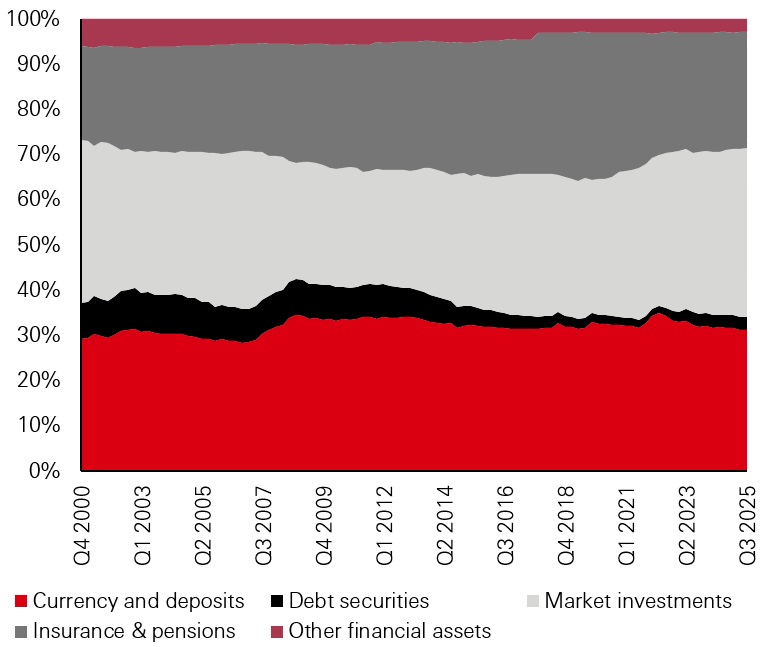
The objective extends beyond financial regulation as Europe has a substantial pool of private savings, but much of it remains in bank deposits rather than being channelled towards productive investment. Mobilising more of this capital could help finance innovation, infrastructure and corporate expansion, while giving European households greater participation in long term investment returns.
Figure 1: Euro area household share of financial assets (per cent)
Click the image to enlarge
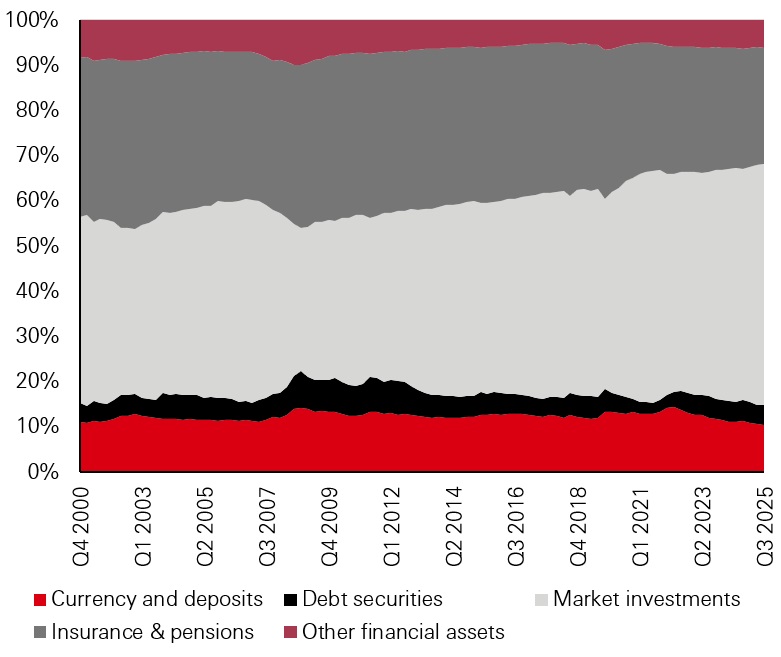
Figure 2: US household share of financial assets (per cent)
Click the image to enlarge
Source: Federal Reserve Bank of St. Louis, OECD, ECB, ECB calculations, HSBC Asset Management. Data as of August 2026.
Europe’s more fragmented capital markets have historically constrained funding efficiency, market depth and the flow of savings into productive investment. By comparison, deeper US capital markets benefit from broader institutional participation, greater liquidity, stronger analyst coverage and more efficient capital allocation. For European companies, this can translate into a higher cost of capital and, in some cases, an incentive to seek financing or listings elsewhere.
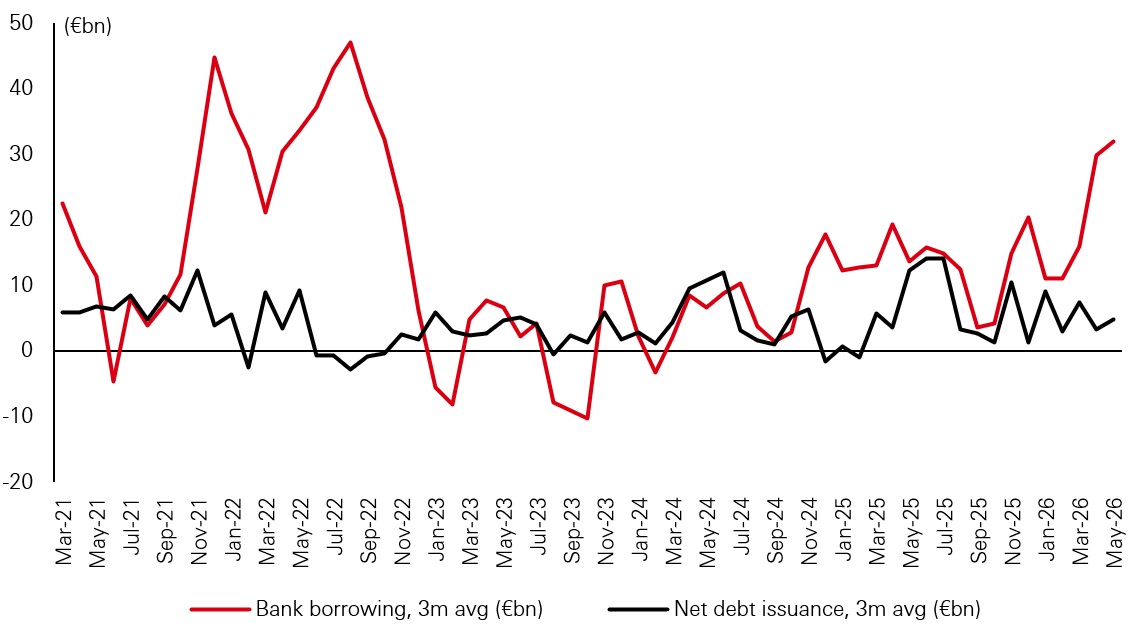
Improving the depth and efficiency of European markets could help address this. Renewed efforts to develop the securitisation market are particularly relevant. A deeper market could broaden funding sources beyond traditional bank lending, distribute credit risk across a wider investor base and potentially free up bank balance sheets to support additional lending to the real economy. For investors, it would also expand the range of income and diversification opportunities available within European fixed income.
Figure 3: Bank loan versus net debt issuance within Euro area (EUR bn)
Click the image to enlarge
Source: ECB, Euro area economic and financial developments by institutional sector: first quarter of 2026, HSBC Asset Management. Data as of July 2026.
The sovereign bond market is another important part of this picture. Recent global uncertainty has strengthened the appeal of euro area government bonds, supported by Europe’s institutional framework, a comparatively predictable monetary policy backdrop and attractive yields in parts of the market. Stronger and deeper sovereign markets can also provide benchmark curves against which corporate, financial and structured credit can be priced, supporting the development of the wider European fixed income market.
This creates an investment opportunity that extends beyond the current level of yields. Greater financial integration could offer more efficient markets for investors, while the development of securitisation and corporate bond markets broadens the opportunity set available to investors. At the same time, more efficient capital allocation could lower financing costs for companies and help direct Europe’s substantial savings towards the investment needed to raise productivity and competitiveness.
The implications are therefore broader than a simple valuation argument. European fixed income offers exposure to sovereign, corporate and structured credit markets at a time when the region is seeking to deepen its capital market architecture and mobilise more domestic savings towards productive investment.
For investors, the opportunity lies in combining today’s income potential with the prospect of a deeper and more diversified European capital market over time. Selectivity remains important across sovereigns, sectors and issuers, but progress of financial integration could strengthen both the quality of financing available to European companies and the range of opportunities available to long term fixed income investors.
Diversification does not ensure a profit or protect against loss. For informational purposes only and should not be construed as a recommendation to invest in the specific country, product, strategy, sector or security. The views expressed above were held at the time of preparation and are subject to change without notice. Any forecast, projection or target where provided is indicative only and not guaranteed in any way. HSBC Asset Management accepts no liability for any failure to meet such forecast, projection or target.
Important information
For Professional Clients and intermediaries within countries and territories set out below; and for Institutional Investors and Financial Advisors in the US. This document should not be distributed to or relied upon by Retail clients/investors.
The value of investments and the income from them can go down as well as up and investors may not get back the amount originally invested. The performance figures contained in this document relate to past performance, which should not be seen as an indication of future returns. Future returns will depend, inter alia, on market conditions, investment manager’s skill, risk level and fees. Where overseas investments are held the rate of currency exchange may cause the value of such investments to go down as well as up. Investments in emerging markets are by their nature higher risk and potentially more volatile than those inherent in some established markets. Economies in emerging markets generally are heavily dependent upon international trade and, accordingly, have been and may continue to be affected adversely by trade barriers, exchange controls, managed adjustments in relative currency values and other protectionist measures imposed or negotiated by the countries and territories with which they trade. These economies also have been and may continue to be affected adversely by economic conditions in the countries and territories in which they trade.
The contents of this document may not be reproduced or further distributed to any person or entity, whether in whole or in part, for any purpose. All non-authorised reproduction or use of this document will be the responsibility of the user and may lead to legal proceedings. The material contained in this document is for general information purposes only and does not constitute advice or a recommendation to buy or sell investments. Some of the statements contained in this document may be considered forward looking statements which provide current expectations or forecasts of future events. Such forward looking statements are not guarantees of future performance or events and involve risks and uncertainties. Actual results may differ materially from those described in such forward-looking statements as a result of various factors. We do not undertake any obligation to update the forward-looking statements contained herein, or to update the reasons why actual results could differ from those projected in the forward-looking statements. This document has no contractual value and is not by any means intended as a solicitation, nor a recommendation for the purchase or sale of any financial instrument in any jurisdiction in which such an offer is not lawful. The views and opinions expressed herein are those of HSBC Asset Management at the time of preparation and are subject to change at any time. These views may not necessarily indicate current portfolios' composition. Individual portfolios managed by HSBC Asset Management primarily reflect individual clients' objectives, risk preferences, time horizon, and market liquidity. Foreign and emerging markets: investments in foreign markets involve risks such as currency rate fluctuations, potential differences in accounting and taxation policies, as well as possible political, economic, and market risks. These risks are heightened for investments in emerging markets which are also subject to greater illiquidity and volatility than developed foreign markets. This commentary is for information purposes only. It is a marketing communication and does not constitute investment advice or a recommendation to any reader of this content to buy or sell investments nor should it be regarded as investment research. It has not been prepared in accordance with legal requirements designed to promote the independence of investment research and is not subject to any prohibition on dealing ahead of its dissemination. This document is not contractually binding nor are we required to provide this to you by any legislative provision.
All data from HSBC Asset Management unless otherwise specified. Any third-party information has been obtained from sources we believe to be reliable, but which we have not independently verified.
HSBC Asset Management is the brand name for the asset management business of HSBC Group, which includes the investment activities that may be provided through our local regulated entities. HSBC Asset Management is a group of companies in many countries and territories throughout the world that are engaged in investment advisory and fund management activities, which are ultimately owned by HSBC Holdings Plc. (HSBC Group).
- In Australia, this document is issued by HSBC Bank Australia Limited ABN 48 006 434 162, AFSL 232595, for HSBC Global Asset Management (Hong Kong) Limited ARBN 132 834 149 and HSBC Global Asset Management (UK) Limited ARBN 633 929 718. This document is for institutional investors only and is not available for distribution to retail clients (as defined under the Corporations Act). HSBC Global Asset Management (Hong Kong) Limited and HSBC Global Asset Management (UK) Limited are exempt from the requirement to hold an Australian financial services license under the Corporations Act in respect of the financial services they provide. HSBC Global Asset Management (Hong Kong) Limited is regulated by the Securities and Futures Commission of Hong Kong under the Hong Kong laws, which differ from Australian laws. HSBC Global Asset Management (UK) Limited is regulated by the Financial Conduct Authority of the United Kingdom and, for the avoidance of doubt, includes the Financial Services Authority of the United Kingdom as it was previously known before 1 April 2013, under the laws of the United Kingdom, which differ from Australian laws;
- In Bermuda, this document is issued by HSBC Global Asset Management (Bermuda) Limited, of 37 Front Street, Hamilton, Bermuda which is licensed to conduct investment business by the Bermuda Monetary Authority;
- In France, Belgium, Netherlands, Luxembourg, Portugal, Greece, Finland, Norway, Denmark, Spain and Sweden this document is issued by HSBC Global Asset Management (France), a Portfolio Management Company authorised by the French regulatory authority AMF (no. GP99026);
- In Germany, this document is issued by HSBC Global Asset Management (Deutschland) GmbH which is regulated by BaFin (German clients) respective by the Austrian Financial Market Supervision FMA (Austrian clients);
- In Hong Kong, this document is issued by HSBC Global Asset Management (Hong Kong) Limited, which is regulated by the Securities and Futures Commission. This content has not been reviewed by the Securities and Futures Commission;
- In India, this document is issued by HSBC Asset Management (India) Pvt Ltd. which is regulated by the Securities and Exchange Board of India;
- In Italy, this document is issued by HSBC Global Asset Management (France), a Portfolio Management Company authorised by the French regulatory authority AMF (no. GP99026), through its Italian branch, regulated by Banca d’Italia and Commissione Nazionale per le Società e la Borsa (Consob);
- In Japan, this document is issued by HSBC Asset Management (Japan) Ltd (JRN 3010001124868), regulated by the Financial Services Agency;
- In Malta, this document is issued by HSBC Global Asset Management (Malta) Limited which is regulated and licensed to conduct Investment Services by the Malta Financial Services Authority under the Investment Services Act;
- In Mexico, this document is issued by HSBC Global Asset Management (Mexico), SA de CV, Sociedad Operadora de Fondos de Inversión, Grupo Financiero HSBC which is regulated by Comisión Nacional Bancaria y de Valores;
- In the United Arab Emirates, this document is issued by HSBC Investment Funds (Luxembourg) S.A. – Dubai Branch (Level 20, HSBC Tower, PO Box 66, Downtown Dubai, United Arab Emirates) regulated by the Capital Market Authority (CMA) in the UAE to conduct investment fund management, portfolios management, fund administration activities (CMA Category 2 license No.20200000336) and promotion activities (CMA Category 5 license No.20200000327).
- In the United Arab Emirates, this document is issued by HSBC Global Asset Management MENA, a unit within HSBC Bank Middle East Limited, U.A.E Branch, PO Box 66 Dubai, UAE, regulated by the Central Bank of the U.A.E. and the Capital Market Authority in the UAE under CMA license number 602004 for the purpose of this promotion and lead regulated by the Dubai Financial Services Authority. HSBC Bank Middle East Limited is a member of the HSBC Group and HSBC Global Asset Management MENA are marketing the relevant product only in a sub-distributing capacity on a principal-to-principal basis. HSBC Global Asset Management MENA may not be licensed under the laws of the recipient’s country of residence and therefore may not be subject to supervision of the local regulator in the recipient’s country of residence. One of more of the products and services of the manufacturer may not have been approved by or registered with the local regulator and the assets may be booked outside of the recipient’s country of residence.
- In Singapore, this document is issued by HSBC Global Asset Management (Singapore) Limited, which is regulated by the Monetary Authority of Singapore. The content in the document/video has not been reviewed by the Monetary Authority of Singapore;
- In Switzerland, this document is issued by HSBC Global Asset Management (Switzerland) AG. This document is intended for professional investor use only. For opting in and opting out according to FinSA, please refer to our website; if you wish to change your client categorization, please inform us. HSBC Global Asset Management (Switzerland) AG having its registered office at Gartenstrasse 26, PO Box, CH-8002 Zurich has a licence as an asset manager of collective investment schemes and as a representative of foreign collective investment schemes. Disputes regarding legal claims between the Client and HSBC Global Asset Management (Switzerland) AG can be settled by an ombudsman in mediation proceedings. HSBC Global Asset Management (Switzerland) AG is affiliated to the ombudsman FINOS having its registered address at Talstrasse 20, 8001 Zurich. There are general risks associated with financial instruments, please refer to the Swiss Banking Association (“SBA”) Brochure “Risks Involved in Trading in Financial Instruments”;
- In Taiwan, this document is issued by HSBC Global Asset Management (Taiwan) Limited which is regulated by the Financial Supervisory Commission R.O.C. (Taiwan);
- In Turkiye, this document is issued by HSBC Asset Management A.S. Turkiye (AMTU) which is regulated by Capital Markets Board of Turkiye. Any information here is not intended to distribute in any jurisdiction where AMTU does not have a right to. Any views here should not be perceived as investment advice, product/service offer and/or promise of income. Information given here might not be suitable for all investors and investors should be giving their own independent decisions. The investment information, comments and advice given herein are not part of investment advice activity. Investment advice services are provided by authorized institutions to persons and entities privately by considering their risk and return preferences, whereas the comments and advice included herein are of a general nature. Therefore, they may not fit your financial situation and risk and return preferences. For this reason, making an investment decision only by relying on the information given herein may not give rise to results that fit your expectations.
- In the UK, this document is issued by HSBC Global Asset Management (UK) Limited, which is authorised and regulated by the Financial Conduct Authority;
- In the US, this document is issued by HSBC Securities (USA) Inc., an HSBC broker dealer registered in the US with the Securities and Exchange Commission under the Securities Exchange Act of 1934. HSBC Securities (USA) Inc. is also a member of NYSE/FINRA/SIPC. HSBC Securities (USA) Inc. is not authorized by or registered with any other non-US regulatory authority. The contents of this document are confidential and may not be reproduced or further distributed to any person or entity, whether in whole or in part, for any purpose without prior written permission.
- In Chile, operations by HSBC's headquarters or other offices of this bank located abroad are not subject to Chilean inspections or regulations and are not covered by warranty of the Chilean state. Obtain information about the state guarantee to deposits at your bank or on www.cmfchile.cl;
- In Colombia, HSBC Bank USA NA has an authorized representative by the Superintendencia Financiera de Colombia (SFC) whereby its activities conform to the General Legal Financial System. SFC has not reviewed the information provided to the investor. This document is for the exclusive use of institutional investors in Colombia and is not for public distribution;
- In Costa Rica, the Fund and any other products or services referenced in this document are not registered with the Superintendencia General de Valores (“SUGEVAL”) and no regulator or government authority has reviewed this document, or the merits of the products and services referenced herein. This document is directed at and intended for institutional investors only.
- In Peru, HSBC Bank USA NA has an authorized representative by the Superintendencia de Banca y Seguros in Perú whereby its activities conform to the General Legal Financial System - Law No. 26702. Funds have not been registered before the Superintendencia del Mercado de Valores (SMV) and are being placed by means of a private offer. SMV has not reviewed the information provided to the investor. This document is for the exclusive use of institutional investors in Perú and is not for public distribution;
- In Uruguay, operations by HSBC's headquarters or other offices of this bank located abroad are not subject to Uruguayan inspections or regulations and are not covered by warranty of the Uruguayan state. Further information may be obtained about the state guarantee to deposits at your bank or on www.bcu.gub.uy
Copyright © HSBC Global Asset Management Limited 2026. All rights reserved. No part of this publication may be reproduced, stored in a retrieval system, or transmitted, on any form or by any means, electronic, mechanical, photocopying, recording, or otherwise, without the prior written permission of HSBC Asset Management.
Content ID: D077578_V1.0; Expiry Date: 31.08.2027