

Multi-Asset Insights
In a nutshell
- Strategic asset allocation is being stress‑tested. A world of regime shifts, larger allocations to illiquids and complex alternatives, and entrenched organisational silos means many portfolios look diversified in theory but behave like concentrated bets when it matters most.
- The Total Portfolio Approach (TPA) flips the lens: the fund is managed as a single economic balance sheet. Every decision is judged by its impact on total fund objectives, risk, liquidity and sustainability – not by whether it “beats the benchmark” within a narrow asset‑class sleeve.
- On the investment side, TPA pushes organisations to look through asset‑class labels to the underlying economic exposures that drive risk and return. The most coherent way to implement this is to build exposures to a small set of investable macro factors.
- In this process, governance and culture become core enablers. Boards concentrate on mission, risk appetite and simple reference portfolios or risk ranges, while CIOs and investment teams are empowered to move dynamically within these guardrails. Incentives and language shift towards “one portfolio, one purpose” instead of siloed scorecards.
- Moving to TPA is usually an evolution, not a revolution. Most investors travel along a spectrum of hybrid models, with governance, analytics and culture often changing at different speeds. In practice, investors looking to adopt a Total Portfolio Approach will need to review their portfolio through macro‑factor lenses, reset governance so boards define the “what and why”, and plan a phased transition towards this new model. External partners can support this journey through factor diagnostics, overlay design, liquidity modelling and implementation.
What is TPA, really?
1. Definition of TPA by its champions and fathers
As already said, the Total Portfolio Approach is often defined very loosely even by its champions, most notably the Chartered Alternative Investment Analyst (CAIA) Association and the Thinking Ahead Institute (WTW), through a set of high-level principles rather than a prescriptive blueprint. Their framing is frequently expressed through five short statements that capture the spirit of the approach.
Taken together, these statements function less like a formal definition and more like a set of signposts: they point to what TPA is trying to achieve without fully specifying what it is. The paragraphs that follow therefore do not attempt to operationalise TPA yet, they simply clarify what each statement is saying at a conceptual level, and how the ideas relate to one another.
TPA is not a predefined strategy, it is a mindset
It is, in effect, a way of organising investment decision-making so the portfolio behaves like a single system to meet the overall fund goals rather than a collection of individual asset class objectives. Beyond the headline, this mindset has huge implications for portfolio construction, investment staff accountability and measures of success.
TPA is all about being prepared
Prepared for shifts in regimes, correlation spikes, liquidity stress, and the recurrent reality that the world will not conform with the stable and static assumptions embedded in standard strategic asset allocation (SAA) frameworks. Many organisations spend a disproportionate amount of time building the conditions for decision-making in normal times before markets stress-test them. In the words of CAIA/Thinking Ahead, “the portfolio is not the point. The point is the process that leads to better outcomes.”
At its core, TPA shifts the focus from managing assets in isolated allocation buckets to viewing the portfolio as a single, integrated entity.
TPA is what you do when you evaluate every investment by its marginal impact on total portfolio outcomes – return, risk, liquidity, and resilience – rather than by whether it “belongs” to a bucket. That sounds self-evident, but it is operationally radical because “asset class buckets” are not just a portfolio construct; they are an organisational design, a reporting language, and often a compensation system.
TPA takes a holistic approach to risk and investment exposures by removing silos from asset allocation.
TPA moves away from risk being defined as compliance with tracking error limits versus benchmarks, and towards risk as the probability of failing the fund’s mission – captured through concepts such as shortfall risk, drawdown or funding gap volatility.
It also encourages investors to think in what actually drives returns and losses in the total portfolio – rates, inflation sensitivity, equity beta, credit stress, liquidity premia, and tail risks – and then to decide how much of each exposure the fund truly wants.
TPA relies on a culture of clear ownership, delegation, trust and alignment.
At a high level, this often means more transparency and a clearer split in responsibilities: the board owns the mission, time horizon and risk appetite; management owns implementation within agreed guardrails; success metrics are consistent with long-term outcomes; and incentives/reward structures do not pull teams back into silo behaviour.
Taken at face value, all these statements can feel deliberately broad – so broad that it is easy to conclude that TPA is more narrative than substance. However, examining what leading pension funds actually do under a TPA label suggests there is more meaningful content behind it than the high-level language might imply.
2. The main tenets in practice
Based on the experience of leading adopters (see table 2), a workable TPA framing typically combines five main tenets:
- First, total fund goals dominate. This means prioritising outcomes at the total fund level (e.g. real return, funding ratio, purchasing power, drawdown resilience) over relative performance against asset-class benchmarks. If teams are rewarded for beating an underlying asset class benchmark, they will likely defend their asset class even when the total portfolio would benefit from reallocating risk elsewhere. TPA tries to reverse that incentive gradient: the total fund objective is primary and can be expressed as a total return target; and not a relative return vs a multi asset benchmark. The approach is the same as regards risk targets. As examples, Australia’s Future Fund aims to deliver CPI +4 per cent to 5 per cent over the long term while Singapore GIC aims to “preserve and enhance the international purchasing power” using a rolling 20-year real rate of return performance metric. UK USS focuses risk discussion on funding gap volatility, better reflecting the ability to meet promised benefits to its members than a traditional tracking error goal
- Second, investments compete for capital. In other words, it shifts the question from “Is this a good investment decision within the asset class?” to “Is this a good investment decision against any alternative use of risk or liquidity?”. Charles Hyde, head of asset allocation at NZ Super describes the discipline in simple terms: a prospective toll road investment should not proceed merely because the infrastructure budget is available, it should proceed only if it is among the most attractive opportunities across the fund, and it might lose that contest to something as different as a global macro strategy. This is why TPA often changes the conversation about ‘niche’ assets or alternative strategies. Those exposures can be hard to defend in a standard SAA framework because they do not always fit cleanly into buckets and may introduce tracking error. By contrast, Australia’s TCorp has been enabled to add exposures such as insurance-linked securities, volatility-linked strategies or niche private market strategies, precisely because they are judged on marginal contribution to total portfolio objectives, not against a benchmark. Similarly, Future Fund’s portfolio incorporates defensive hedge funds with zero or negative beta and a substantial venture capital allocation
- Third, portfolios are structured by risk-factors exposures rather than by asset class labels. In many traditional SAA frameworks, the institution is encouraged to believe that resilience comes from diversification across asset class labelled buckets. But asset class diversification is not the same as risk-factor diversification, and it often underestimates how quickly apparent diversification can disappear. The practical discipline is to understand what actually drives returns and losses in the total portfolio – rates, inflation sensitivity, equity beta, liquidity premia, tail risks – and then to decide how much exposure to each risk factor the fund truly wants. Canada CPPIB is an explicit case study: it runs its Total Portfolio Investment Framework through a factor lens (growth, rates, credit spreads, etc.), mapping public and private markets exposures onto a selected factor set. Then, CPPIB can use a portfolio of liquid public market securities to do some rebalancing and avoid unintended factor drift as markets move. The total portfolio factor shape is an explicit object of control
- Fourth, the framework supports dynamism and flexibility. However, TPA does not mean high frequency trading; it means that the institution is not structurally prevented from acting when action is justified. It is an acknowledgement that risk premia, correlations and liquidity conditions are not stationary and that the portfolio needs a credible mechanism for adapting without rewriting the whole governance framework each time. GIC’s approach is a concrete operational example: a long-term policy portfolio is complemented by medium-horizon strategy buckets and 3-5‑year overlays, allowing the CIO office to address shorter-term funding needs or themes without destabilising long-term holdings. Similarly, CPPIB and Calpers are using completion portfolios to be more flexible in positioning and risk management while NZ Super uses time-varying risk budgets. Under SAA, tactical decisions’ centre of gravity is still the policy benchmark, so active management is framed as deviation. Under TPA, investment decisions are framed as solving for what is best for the total portfolio with fewer arbitrary constraints
- Fifth, ‘one team’ is a culture requirement. If teams are incentivised to win only within their silos, the total portfolio will likely lose through duplicated exposures, missed cross-asset opportunities and an institutional bias toward what is easy to explain rather than what is efficient. Because this is both the most central enabler of TPA and one of the hardest to execute as it depends as much on incentives and soft skills as on process, we will review it in much more detail later in this paper
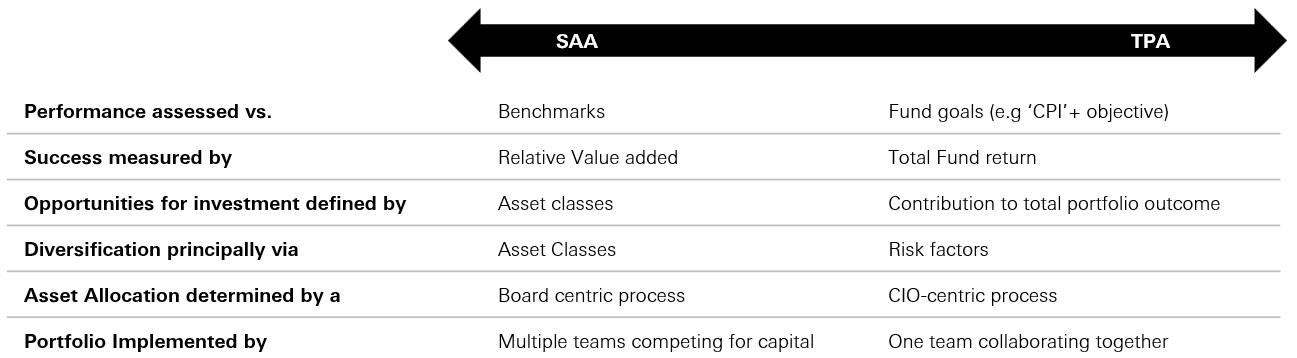
In a nutshell, TPA principles are often presented alongside a stylised contrast with the SAA approach as per table 1 below:
Table 1: From SAA to TPA
Click image to enlarge
Source: Thinking Ahead Institute, HSBC Asset Management, September 2026.
While useful as a first illustration, these comparisons can be somewhat caricatured—implicitly portraying SAA as highly static and mechanically ‘set-and-forget’. In practice, many asset owners today already run more flexible SAA frameworks, with active rebalancing, broader opportunity sets and a greater focus on total portfolio risk. As a result, the real difference between SAA and TPA is often more nuanced than table 1 suggests.
Besides, these dimensions are not a checklist to be completed in one go. Institutions can choose to act on different components depending on constraints such as governance model, staffing, and operational framework. TPA has both ‘hard’ elements, like portfolio construction tools and risk systems, and ‘soft’ elements, like language, incentives, and trust, the latter being probably the most challenging. Treating it as one-size-fits-all is a reliable way to fail.
All of this reinforces why we see TPA as a collection of best practices rather than a single ‘model’ to absolutely transition to. Indeed, one of the most important findings of CAIA and the Thinking Ahead Institute is that ‘the portfolio is a byproduct of the journey’. The same institution can be ‘TPA-like’ in governance and risk, and still be more conventional in its asset mix; another can hold many ‘esoteric’ assets yet still behave like an SAA shop because incentives and decision-making remain bucketed.
And yes, many asset owners already do elements of TPA without knowing it. Whenever an investor runs a completion portfolio, uses overlays to manage macro risk without impacting long-term holdings, reallocates risk based on opportunity cost rather than funding from the nearest bucket, or evaluates an investment by its marginal contribution to total portfolio resilience, they are already in TPA territory – whether they call it that or not.
3. A brief history: not born in academia, but enabled by it
TPA per se did not originate as an academic model. It emerged as a practitioner concept – particularly among large asset owners in Canada, Australia, New Zealand, and Singapore – and relied on some academic advances around factor models, time-varying premia, regime dependence, and liquidity-aware portfolio construction.
WTW and CAIA are tracking progress of TPA adoption, noting that among a 26‑fund global peer group, SAA use has fallen by half since 2017, 35 per cent have adopted TPA and 54 per cent expect to move that way. Among large asset owners, TPA adopters are notably:
Table 2: Early adopters of TPA
| Organisation | Country |
|---|---|
| Alaska Permanent Fund | United States |
| APG | Netherlands |
| CalPERS | United States |
| CPPIB | Canada |
| Future Fund | Australia |
| GIC | Singapore |
| NZ Super | New Zealand |
| PSP | Canada |
| Railpen | United Kingdom |
| TCorp | Australia |
| Universities Superannuation Fund (USS) | United Kingdom |
| SWIB | United States |
Source: Thinking Ahead Institute, HSBC Asset Management, September 2026.
Two structural drivers explain why TPA has grown in popularity recently.
- First, the opportunity set identified by asset owners has structurally shifted towards private markets. CAIA’s work quantifies alternative investments at roughly USD 22tn of assets under management and about 15 per cent of the global investable universe, alongside approximately USD 57.4tn in global equities and USD 62.5tn in global bonds. As the largest pension funds and sovereign wealth funds’ private holdings grow, the question is no longer whether to hold illiquid assets, but how to combine them coherently with liquid exposures. Private and public assets cannot be constructed independently without risking unintended concentrations, mismatched liquidity buffers, or a portfolio that looks diversified ‘by bucket’ but behaves very differently under stress. A more holistic approach is therefore required, one that considers liquid and illiquid exposures jointly within a single portfolio approach based on a factor framework
- Second, recent macro regime changes have challenged the simple diversification assumptions embedded in many SAA frameworks. When stocks and bonds sell off together—as they did in the 2022 inflation shock – asset-class labels provide little comfort. A framework that starts with macro factors drivers rather than asset buckets is no longer an intellectual preference; it leads to better portfolio resilience
TPA investment approach: why “factor thinking” is the centre of gravity
In our view, TPA’s most important contribution is that strategic asset allocation should be expressed in the language of underlying drivers of risk and return, not in the language of asset categories. Concretely, it means that we should switch from an SAA (strategic asset allocation) to SFA (strategic factor allocation). As already mentioned, CPPIB is likely the best example of an asset owner having built an investment process through a factor lens, but the concept shows up in other TPA adopters as well: New Zealand Super explicitly monitors portfolio ‘factor weights’ while Future Fund frames diversification through cross-portfolio characteristics such as Equivalent Equity Exposure (EEE).
This principle is strongly aligned with the academic factor investing literature. Andrew Ang, a leading scholar on factor-based portfolio construction, conveys the idea with a great analogy: “factors are to investing what nutrients are to food”. Ang’s analogy exposes the illusion of diversification by label. Food products (chicken, beans, etc.) are the packaging; nutrients (protein, vitamins, fats, etc.) are the underlying exposures. Similarly, asset classes are packaging, while risk factors are underlying exposures. And, crucially, different packages can deliver similar exposures. In his framework, factors are the fundamental building blocks of portfolio risk and expected returns, while assets are simply the vehicles that package those factors in different proportions.
Using various statistical techniques, it can be shown that only a handful of risk factors explain the bulk of the risk and return of a broad universe of assets.
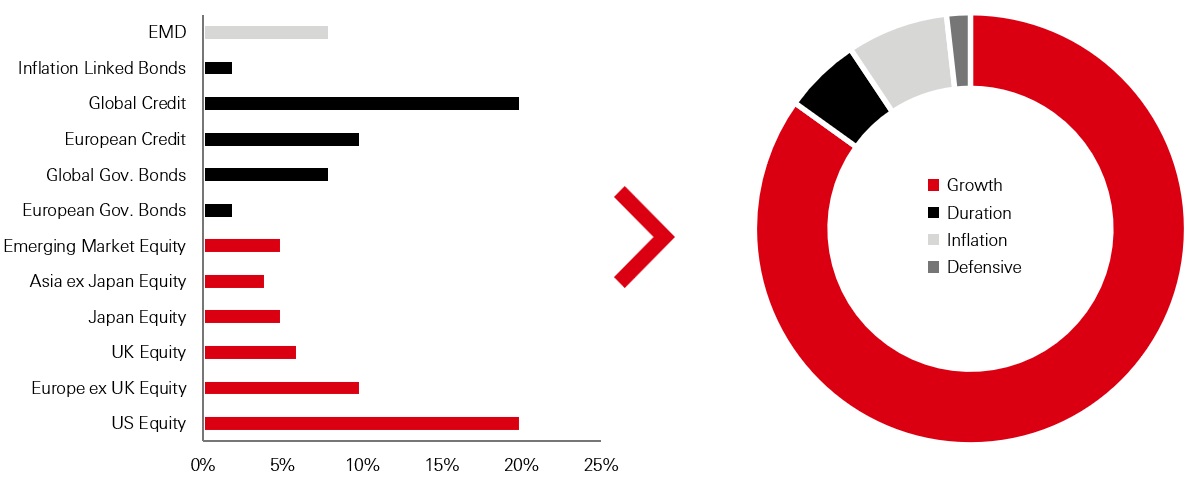
Figure 1: From a traditional asset class view to macro factor lens
Click image to enlarge
Source: HSBC Asset Management, September 2026.
It is exactly why many institutions feel diversified – right up to the moment they are not. Traditional asset-class diversification can mask concentration in a small number of underlying macro risk factors – most notably equity-linked growth risk (figure 1). That concentration often becomes visible at the worst possible moment: during market stress, when liquidity becomes scarce and correlations between risky assets increase dramatically. For investment committees, the implication is practical: a portfolio can be diversified on paper but concentrated in reality. That is a governance risk as much as an investment risk.
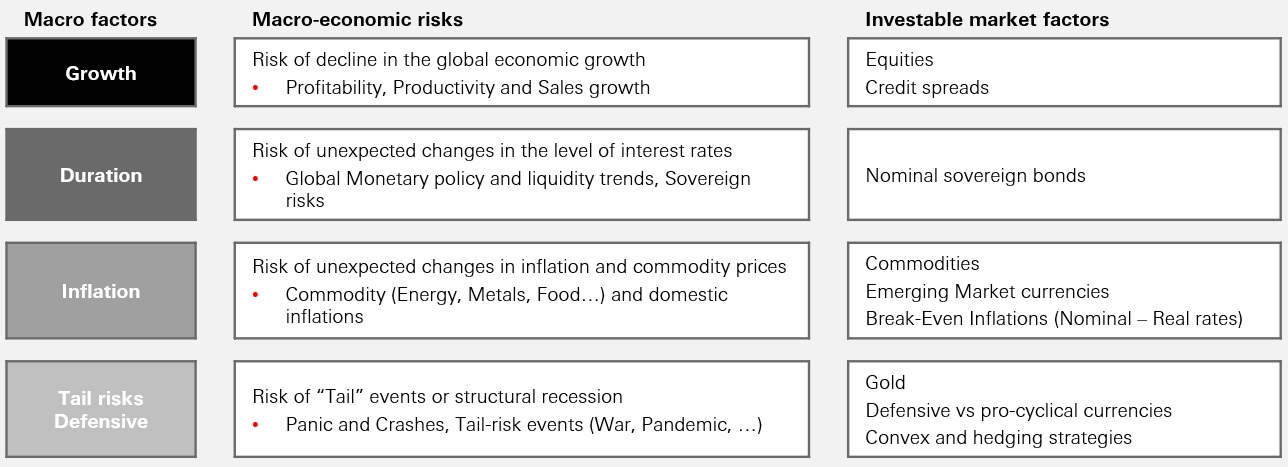
While there are many design choices possible when moving to an investment factor-based framework, in practice the first step is to define a set of macro factors1, relatively independent of each other, that underlie the returns of many types of investment. Usual suspects are the growth, duration and inflation factors which are well-recognised economic forces driving asset performance cycles and are supported by academic research. A fourth defensive factor potentially negatively correlated to the three previous macro factors can also be identified. It is related to true alternative asset classes offering resilience and protection in stressful market (geopolitical) or economic (stagflationary) environments.
Growth captures sensitivity to the profitability and growth cycles and is closely linked to equity markets and credit spreads. Duration captures exposure to nominal rate risk and monetary cycles. Inflation captures sensitivity to unexpected inflation and commodity cycles, including breakeven inflation risk. Quantitative studies suggest that those three risk factors only explain around 80 per cent of the total risk for a diversified investment universe.
Using statistical analysis, the sensitivity of individual asset classes can be assessed against the selected macro factors. This mapping presents, in a structured and transparent way, the key macro forces driving asset classes’ absolute returns and correlations.
Therefore, the primary strategic decision is to build what could be described as a strategic factor allocation, that is, the desired long-term exposure to each factor, which sets a long-run risk budget consistent with the institution’s objectives. The SFA can then be used as a reference portfolio, and only subsequently translated into an implementable asset-class mix.
1 - Academic research typically distinguishes between two types of factors. Macro factors are fundamental sources of risk related to the global economic environment and are perceived as ‘directional’, driving absolute returns across assets classes. Style factors, are characteristics commonly shared by a group of assets which consistently explains assets’ relative returns within asset classes, i.e. returns in excess of the return of the relevant asset-class return.
Four features of this SFA approach are directly relevant to the TPA debate.
- First, moving from asset-based decisions to factor-based decisions helps focus governance debate on the few choices that matter most over long horizons, anchored in economic intuition. Institutions should deliberately choose the factor exposures that best match their objectives and tolerance for losses in adverse environments as a first decision. It reduces decision complexity by reducing the dimension of the investment problem and clarifies decision ownership
- Second, it makes visible what is usually hidden: many portfolios are structurally long growth and duration, but short of structural inflation resilience and explicit defensive convexity. The framework forces the conversation away from “how much in X asset class” toward “how much exposure do we truly have to the regimes that can impair our mission?” By mapping the investable universe to those forces, we can design diversification that is more stable across regimes
- Third, and linked to the previous one, it gives a clear framework to the TPA claim that every investment must earn its way into the portfolio. New assets or strategies should be recommended only if they measurably improve the portfolio’s factor mix and can be implemented under institutional constraints such as liquidity, capacity, valuation frequency, and rebalancing discipline. Some of the most reliable crisis diversifiers are often under-allocated precisely because they look ‘uncomfortable’ in a siloed framework. The best example is CTA strategies, where the uniqueness of their defensive role becomes evident in a factor-based framework, while they are often only treated as a small part of a modest hedge fund allocation under an SAA framework
- Finally, factor framing is the bridge between public and private assets. If private equity shares a lot of similar features with a levered small cap equity exposure, the relevant question is whether the portfolio is not taking too much growth risk and overpaying for it through an illiquid wrapper. Competition for capital therefore becomes a governance discipline: if an institution chooses illiquidity, it should be because it expects to be rewarded for it, not because the bucket demands it
These are, in substance, the benefits of ‘TPA investing through a factor lens: it clarifies desired macro exposures, allows optimal asset implementations consistent with that target and enables organisations to build more robust and resilient portfolios.
Factor-based framework in practice
Our practical application of the framework is similar to approaches suggested in literature2, in that factors are built from asset returns and we select a limited number of factors based on intuition and economic priors. The focus is on macro factors3 which are:
- Intuitive: easily linked to economic theory
- Persistent: reliable over long horizons
- Investable: constructed from one or more investable market factors
- Good proxies for economic variables
Using a combination of statistical analysis and economic intuition, four macro factors are selected that are seen as fundamental sources of risk related to the global economic environment that consistently explain asset classes’ long-term return/risk profiles: growth, duration, inflation and defensive (tail risks).
While the first three factors are well-established as discussed earlier, the defensive factor captures crisis convexity and safe-haven behaviour, including exposures such as gold, selected currencies, and convex strategies like long volatility or trend following. Its statistical properties support its diversification potential against drawdowns in the growth factor. In our view, a defensive building block is necessary for any long-term strategic allocation intended to navigate diverse phases of economic cycles.
Macro factors are intuitively related to a variety of market factors (e.g. equity, nominal rate, credit-spread, commodity risks) which can be defined as the basic building blocks of asset classes. Two key characteristics follow:
- A given macro factor can influence one or more asset classes. For instance, the growth factor is related to equity and credit-spread risks hence impacts both equity and corporate bond type investments
- A given asset class can be exposed to several macro factors. For example, corporate bonds are exposed to both monetary policy (duration) and economic growth (credit-spread) risks. Hence, they are exposed both to the growth and duration macro factors
Figure 2: Mapping illustration between macro factors, economic variables and investable market factors
Click image to enlarge
Source: HSBC Asset Management, September 2026.
2 - Blyth et al. (2016), Greenberg et al. (2016) and Bass et al. (2017)
3 - Based on research from Ang et al. (2009) and Ang (2013)
Macro factors returns are simply calculated as the combination of the returns of the Investable Market factors they are related to. For instance, Growth factor returns are constructed as a combination of equity returns and credit-spread returns.
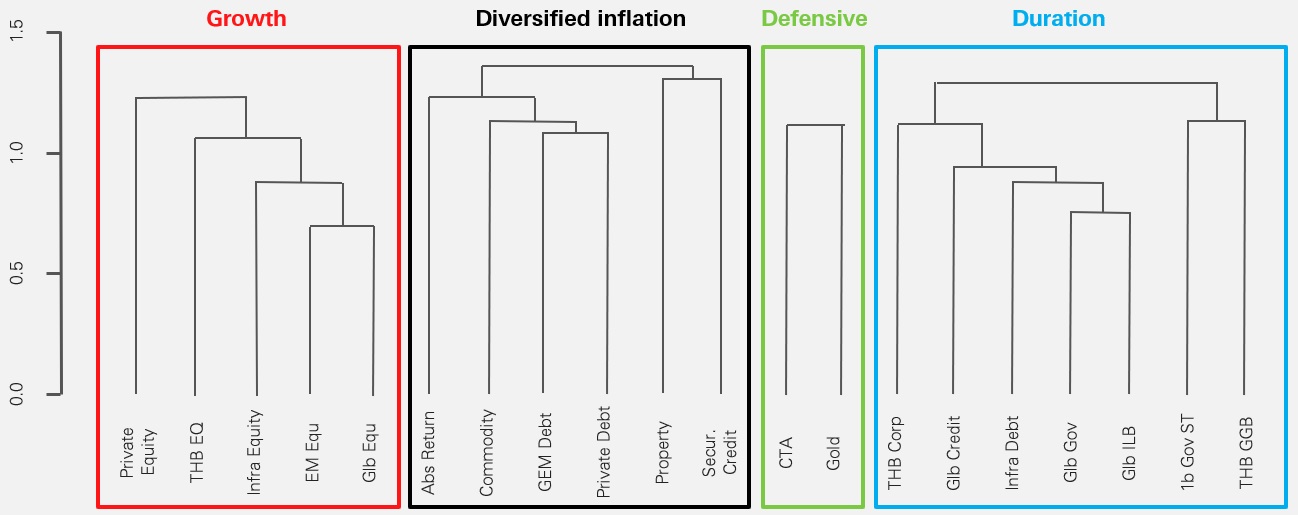
Then, we can derive a limited number of asset roles by grouping assets from the investable universe by conducting a hierarchical clustering analysis. This is a form of unsupervised machine learning which groups assets based on their ‘similarity’, which should take the degree to which assets co-move into account.
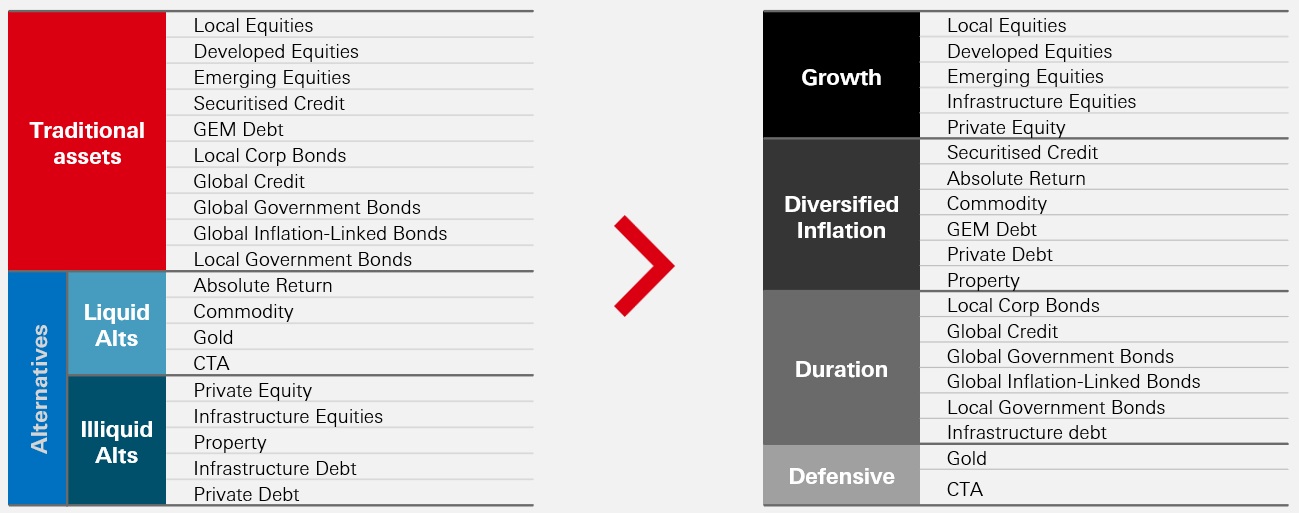
Four clusters can be identified, leading to asset roles identified through the macro factors lens.
Figure 3: Cluster dendrogram based on beta to macro factors
Click image to enlarge
Source: HSBC Asset Management, September 2026.
The same asset classes can be grouped in the conventional categories (SAA) or according to their underlying risk exposures (TPA), thereby capturing the benefits outlined earlier in this section.
Figure 4: Asset classes silos vs. HSBC macro factors lens - Same 19 building blocks, different groupings
Click image to enlarge
Source: HSBC Asset Management, September 2026.
TPA culture: “one portfolio, one purpose”
Experience from early adopters of TPA suggests that, among all its practices, those relating to organisational design and cultural alignment can be the hardest to implement. Success largely depends on how people are incentivised, how decisions are made, and relevant KPIs. A recurring theme for success is “one portfolio, one purpose”: collaboration becomes the DNA of the investment organisation. Breaking down silos between teams and cultivating joined-up decision-making ensures that the best ideas are evaluated for their contribution to the total portfolio, rather than being trapped within product or asset-class lines. Maintaining this mindset is an active, ongoing effort. Future Fund, despite being a pioneer, reports a persistent ‘gravitational pull’ back toward SAA-like behaviours, including the desire for benchmarks, the temptation to revert to asset-class silos, and comfort with traditional metrics such as tracking error (especially under stress and under external pressures like peer comparisons, board turnover, consultant recommendations, and media narratives). Let’s review a few best practices as regards TPA culture.
First, an explicitly long investment horizon supports a portfolio that is resilient to regime change and structural trends, and it underpins a culture that emphasises fundamental value over short-term price movements. GIC’s “One GIC” mindset is a useful illustration: their performance metric agreed with their client – the government of Singapore – is a 20-year rolling real rate of return, which is an explicit cultural anchor to long-horizon outcomes. They also stress agility as a core attribute, considered as the ability to make active decisions in different regimes at the individual, team, and portfolio levels.
Second, to reinforce this one-portfolio mindset, organisations can change their language. This may look a bit artificial, but it is a strong symbol! The idea is to remove any terms that refer to ownership of portfolio slices. Future Fund is the clearest example as it explicitly avoids terms like ‘my portfolio’ and ‘benchmarks’, structures its team around four ‘pillars’ (not asset classes), and operates with centralised functions dedicated to portfolio integration. This is reinforced through deliberate vocabulary with a shift away from ‘benchmarks’, ‘sleeves’ and ‘asset classes’, towards ‘growth’, ‘income’, ‘themes’, ‘portfolio impact’ and ‘contribution’. New hires and board members are explicitly trained in the vocabulary and philosophy of TPA to counter the tendency to revert to familiar SAA language.
Third, to surface best ideas, organisations should invest in cross-functional working groups, centralised research, and regular portfolio-wide communication. Future Fund and GIC use cross-functional working groups bringing together specialists from different pillars to collaborate on portfolio-level themes (examples cited include AI, geopolitics, and technological innovation). CPPIB maintains a centralised portfolio construction group tasked with bringing together exposures across all asset classes and teams into a coherent view of the overall portfolio.
Fourth, compensation systems are redesigned so that bonuses and promotions depend not only on sleeve outperformance, but also on contribution to total portfolio outcomes and collaborative behaviour. At SWIB, portfolio managers are accountable for both individual strategies and their contribution to the overall fund, supported by governance structures that reward long-term decision-making and shared responsibility for total portfolio results. At CalPERS, collaboration is currently an explicit assessment criterion for the most senior management, representing 10 per cent of their performance metrics, while a compensation review is underway, considering extending collaboration as a performance target to less senior investment staff.
TPA governance: a clear and robust decision-making framework with more accountability
Roger Urwin, co-founder of the Thinking Ahead Institute thinks that “SAA is comfortable governance but clunky portfolio management. TPA is efficient portfolio management but ‘stretchy’ governance”. TPA requires a governing body that is willing to accept more complex, judgement-based oversight. The essential ingredient is a clear separation between problem setting at the board level and problem solving by the management team and, where relevant, external partners.
Under traditional SAA model, boards often own both the outcome and the portfolio design. They approve the policy mix in detail, set specific benchmarks and hold the CIO accountable for implementation within that structure. This can blur accountability: when performance disappoints, it can be unclear whether the problem is that the policy portfolio was ill suited, that implementation was poor, or that exogenous conditions dominated both. In a TPA context, governance is recast. The governing body is responsible for clearly specifying the mission, the acceptable risk profile and any hard constraints. CPPIB frames the role of the governing body as to “set the problem up very clearly”, then the question becomes how much latitude management has to solve it.
That delegation to management to solve the problem may be expressed in several ways. Some boards articulate long term absolute return objectives with associated risk parameters; others also define a simple reference portfolio – a notional mix of low cost, liquid assets that captures the intended level of risk and broad market exposure.
In either case, management has latitude to deviate from the reference or ranges in pursuit of better outcomes; the value added (or lost) through those deviations can then be measured transparently. In practice, boards of NZ Super, CPPIB, GIC or Calpers own a simple reference portfolio that reflects the fund’s risk appetite and long-term purpose, while delegating active management to the CIO and investment team. The board focuses on policy and purpose; investment teams gain agility and accountability within an agreed set of operational guardrails. These guardrails are often expressed in terms of acceptable ranges of exposure to growth sensitivity, duration and illiquidity factors rather than fixed asset class weights.
This realignment also entails a shift in risk metrics. Instead of focusing primarily on tracking error to asset class benchmarks, risk oversight under TPA focuses on multiple metrics. GIC calibrates risk not by tracking error limits, but by inflation resilience, cost of capital, and expected drawdowns. At USS, the investment team focuses on funding gap volatility, which better aligns with the fund’s liabilities and long-term promises to beneficiaries. As governance stretches, performance evaluation naturally becomes more complex and multidimensional. Assessing success requires a view of total fund outcomes across time, incorporating contribution to objectives, risk adjusted returns, liquidity resilience, rather than relying solely on tracking error and peer-relative scores at the mandate level.
Challenges: is TPA for everyone?
Implementing the set of positive attributes associated with TPA discussed in this paper is rarely straightforward in large organisations, and investors should keep a number of practical implementation challenges in mind as they assess whether, and how far, TPA is right for them. A lot of TPA core ideas can go against standard approaches, and we know that it is “much better for reputation to fail conventionally than to succeed unconventionally“ (Keynes). In practice, most principles conflict with standard approaches: capital competition conflicts with silo accountability, factor-based oversight conflicts with benchmark-based reporting, dynamism conflicts with governance comfort, “One team” conflicts with how organisations hire, promote, and reward people.
TPA is a change management process and requires bold leadership, a clear vision and patience! Without that, organisations tend to implement isolated elements (new analytics, new committees, a “reference portfolio”) but can fall back to legacy asset-class habits when scrutiny rises due to market stress, stakeholder pressure, or performance drawdowns. Longevity is essential because TPA is a multi-year process. Governance redesign, capability building, and systems upgrades rarely fit within short leadership cycles. If the institution has a low tolerance for transition risk or organisational ambiguity, it may struggle to sustain the effort long enough to see benefits. A realistic transition frequently involves parallel-running old and new frameworks for a period – e.g. maintaining asset-class limits while introducing factor limits, or continuing benchmark reporting while adding absolute and factor-based objectives. That dual framework can temporarily increase workload and create conflicting signals.
Examples of classic failure are the following:
- TPA in reporting, SAA in decisions. Teams may produce factor dashboards and risk decompositions, but capital still gets allocated via the previous risk budget, allocated mandate-by-mandate
- Decision bottlenecks. More cross-asset trades require more coordination, but governance is not redesigned, so approvals slow down. It can also create communication overload: stakeholders need repeated education on why a factor exposure is being taken through an unfamiliar instrument (e.g., derivatives, overlays, portable alpha)
Buy-in from both the board and the investment team is key. The board must be comfortable delegating meaningful implementation authority and accepting a more nuanced performance assessment than simple benchmark-relative metrics. The investment team must accept accountability for total portfolio outcomes rather than only single mandate results. If either side is not aligned, TPA can be quickly stopped or implemented reluctantly by people waiting for its failure. Another challenge is whether the investment team can genuinely be adaptive. This requires specialist talent capable of forming views on time-varying risk premia, and construct portfolios using factor and sensitivity frameworks. There are relatively few investment practitioners who can execute adaptive cross-asset strategies consistently and explain them clearly to stakeholders.
Concrete governance friction points often arise around risk budgets including:
- setting and monitoring factor risk limits (equity beta, duration, credit, inflation, FX) is more complex than policing bucket weights;
- delegation boundaries: how far can the team deviate from a reference portfolio, and for how long, before escalation is required?
- performance narratives: explaining why a decision that lost money was still correct ex ante (e.g., paying carry for insurance, holding liquidity in stressed markets)
TPA also demands greater dynamism and agility, yet many large asset owners are culturally wired for prudence and caution. Prudence is healthy, but it can become a barrier if it translates into slow decisions, committee overload, excessive reliance on consultants, or rigid adherence to fixed bucket weights and rebalancing rules regardless of switching regimes. TPA tends to require more frequent decisions. However, beware of too much agility. Flexibility can lead to overreaction, particularly excessive de-risking during volatile periods. Agility must be paired with institutionalised contrarian behaviour: clear guardrails, disciplined rebalancing, and governance that supports acting against consensus when valuations and risk premia warrant it. Concrete guardrails that often help include predefined rebalancing bands or explicit drawdown and liquidity triggers linked to action plans.
Last but not least, operational resources can be decisive. TPA needs robust data infrastructure, including real-time data on liquidity, factor exposures, leverage, and concentrations. Many organisations are held back by legacy systems, fragmented data, and slow reporting. TPA increases the need for consistent look-through, which is challenging as fund-of-funds, commingled vehicles, or opaque strategies may not provide position-level transparency. Without it, a portfolio can unintentionally duplicate the same risk.
Finally, TPA also comes with reporting challenges. Explaining a factor tilt (e.g., reduced equity beta, higher inflation sensitivity) is harder than explaining a simple overweight of equities. Stakeholders may compare results to peers who are still benchmark-driven, especially in short evaluation windows, creating different performance interpretations. Factor-based attribution can conflict with manager-based attribution, creating competing ‘stories’ about what drove returns.
In summary, it is clear that there are some significant challenges to the transition to TPA and experience across a wide range of asset owners indicates that a successful approach requires gradual TPA adoption. Institutions tend to move along a spectrum of hybrid models that blend elements of SAA and TPA, in ways that fit their objectives, governance constraints, and operational maturity. More details on the transition models to TPA can be found in the appendix.
The role of OCIO asset managers in TPA transition
Many asset owners, particularly those with small internal teams or complex stakeholder environments, can find it difficult to build all the necessary TPA capabilities internally. Asset management firms that already implement best practices of TPA and work closely with institutional allocators – in advisory, delegated CIO or multi‑asset mandates – are therefore natural partners in TPA‑inspired transformations.
The role of such partners is not to offer a generic TPA “product” but to help asset owners implement TPA principles to the extent that their governance and resources allow. At the governance level, external partners can help clients formulate clear problem statements and objectives, an essential starting point. They can support boards in distinguishing between ownership of outcomes and ownership of the portfolio, in designing reference‑portfolio or risk‑range frameworks and in structuring delegation to management. Diagnostic tools developed in the peer‑study literature can be adapted to place each client along the SAA–TPA spectrum, thereby helping to set realistic expectations for the pace and scope of change.
On the analytical side, external partners are also well placed to bring factor‑based mapping of all client exposures – including private markets funds – under a common macro‑factor framework.
They can run structured diagnostics on client portfolios by mapping each asset and strategy to the four macro factors – growth, duration, inflation and defensive – and assessing factor coverage and hidden concentrations. This helps clarify the roles of existing assets in the total portfolio, identify where inflation- or defensive‑sensitive building blocks are under‑represented, and propose additions or rationalisations that improve macro‑factor diversification without compromising liquidity, capacity or rebalancing discipline.
They can also supply liquidity forecasting, capital‑call modelling and balance‑sheet simulation that quantify the opportunity cost of illiquidity and inform pacing and funding decisions. Integrated dashboards that bring together factor exposures, risk metrics, sustainability indicators and scenario analyses at the total‑portfolio level are another area where scale and specialised technology can be leveraged.
Implementation is a third domain in which OCIO asset managers can add value. Completion and overlay portfolios operated on behalf of clients can implement factor‑based tilts, express macro views and manage funding and rebalancing constraints, allowing the underlying mandates to remain focused on their long‑term objectives. Manager architectures can be rationalised, with fewer but deeper relationships in which external partners are treated as knowledge partners and extensions of the internal team.
Finally, they can also help to change culture and get buy-in by stakeholders and investment teams. They bring another perspective and help to position current practices vs state-of-the-art approaches. They can demonstrate successful examples from peers and explain how they can be repeated. Implementing best practices themselves, particularly in investment management, reinforces their credibility: they have skin in the game and aligned interests. If a factor-based approach does not work for the asset owner, it will also fail for the OCIO manager. As they do not belong to the organisation, they can also be viewed as neutral and focused on doing the right thing. Our experience as an OCIO manager has shown us that an external partner can help to unlock a lot of internal conflicts and help to make significant changes in large organisations. Of course, it relies a lot on the expertise and experience of the OCIO manager especially to educate and manage stakeholders’ expectations.
Conclusion
The total portfolio approach tends to polarise reactions. On one side, it is presented as a revolution that renders traditional strategic asset allocation obsolete. On the other side, it is dismissed as a neat label with more marketing than substance. The reality is simpler. TPA doesn’t introduce entirely new techniques that investors couldn’t access through other frameworks; it brings established best practices together into a single aligned approach to decision-making.
In that sense, what it can do is materially improve the odds of delivering on the fund’s mission by tackling familiar institutional failure points: siloed decision-making, diversification-by-label, misaligned incentives, and governance processes that blur accountability.
This is where the “narrative” element is not a weakness but a feature. A compelling story about a new approach (even if it is exaggerated) can be helpful to earn attention and approval from stakeholders to adopt a better framework – from factor-aware portfolio construction to clearer separation between problem-setting (board) and problem-solving (CIO). Then, TPA is doing valuable work! It becomes a practical way to package complexity into a single, intelligible block that teams can rally around ‘one portfolio, one purpose’.
So, TPA is not a revolution, and it is not a hollow rebrand either. It is a credible, evidence-backed narrative that helps institutions implement good practices at pace, secure buy-in across governance layers, and translate sound investment principles into a better investment process.
Appendix - Transition paths and hybrid models
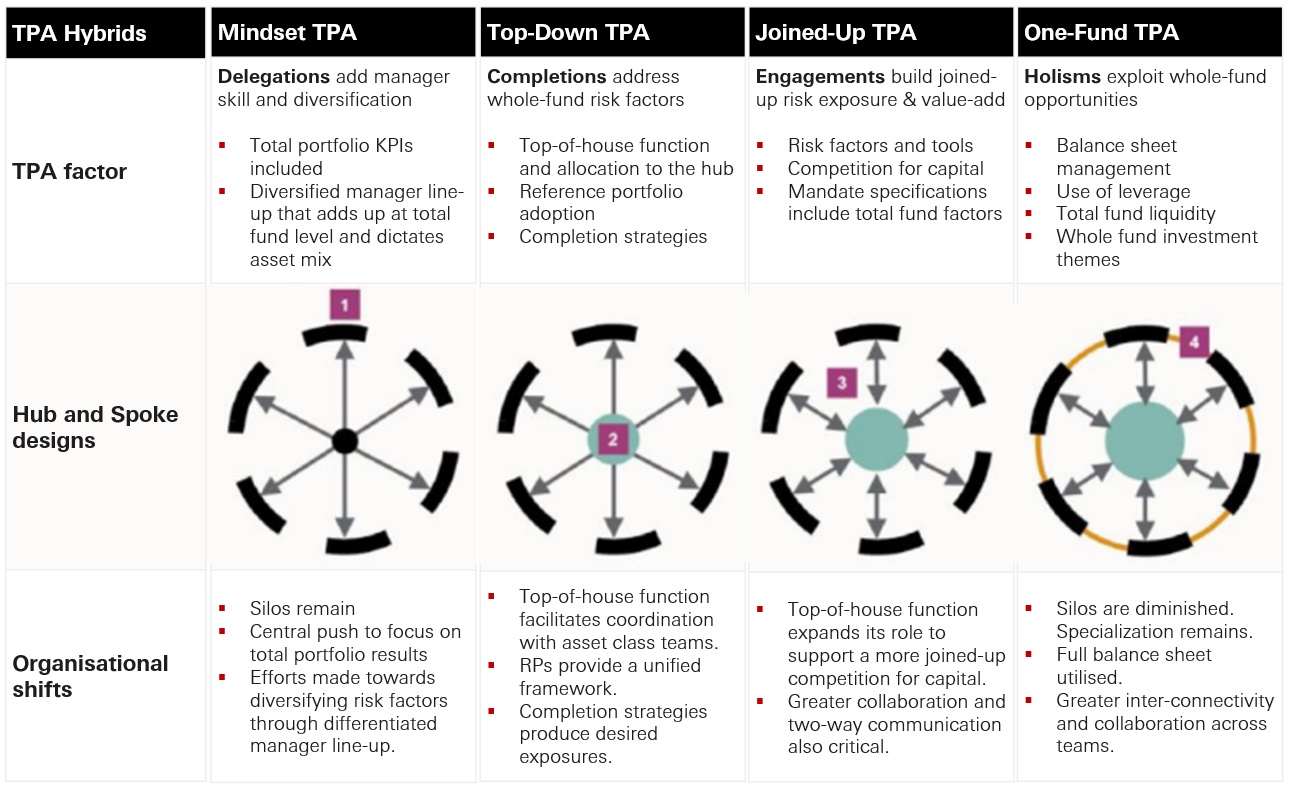
Experience across a wide range of asset owners indicates that TPA is rarely adopted in a single leap. Institutions tend to move along a spectrum of hybrid models that blend elements of SAA and TPA. Traditional SAA models retain the two-stage sequence of policy setting and implementation but may begin to assess outcomes at the total portfolio level or to add simple joined up features.
Click image to enlarge
Source: Thinking Ahead Institute, WTW, September 2026.
Mindset and top-down TPA models maintain legacy SAA structures but introduce top-down innovations – reference portfolios, overlays, dynamic tilts, shadow portfolios – that experiment with total portfolio thinking. Joined up and one fund TPA models break down silos, institutionalise competition for capital and fully integrate liquidity, trading and balance sheet management.
The mindset TPA focuses on shifting how people think, without yet fully altering underlying structures. Top-down TPA adds new frameworks that sit alongside legacy systems. Joined up TPA is a more fully integrated model, with the dimensions aligned and reinforcing each other. One fund TPA is the most developed form, where the approach is comprehensive and the dimensions are consistently embedded across the organisation.
Importantly, the model does not need to be uniform. A fund might have highly developed governance but relatively nascent sustainability integration, for example. This nuance matters for external partners, who should tailor support to the client’s position on each dimension rather than assuming a homogeneous level of maturity. Experience suggests that most institutions progress through these stages over multiple years rather than leaping directly to one fund TPA. Governance, data and culture often advance at different speeds across dimensions, so maturity can be deliberately uneven as capabilities develop.
At the portfolio level, these transitions have visible consequences. Many TPA adopters report a broadening of the investable universe to include satellite exposures that do not fit neat asset class categories but can be additive when judged through a total portfolio lens. In many cases, TPA adopters also demonstrate a different attitude towards illiquidity, treating it as a portfolio level attribute aligned with liabilities rather than something to be tightly constrained at the asset class level.
From the perspective of an asset management firm, these observations suggest that asset owners will increasingly look for partners who can provide not just conventional asset class products but also carefully structured satellite strategies and overlay capabilities that interact coherently with the total portfolio design.
References
- CAIA Association/Thinking Ahead Institute, Innovation Unleashed: the rise of Total Portfolio Approach, 2025
- CAIA Association/Thinking Ahead Institute, From vision to execution, how investors are operationalizing the Total Portfolio Approach, 2026
- Blyth, Szigety and Xia, Flexible Indeterminate Factor-Based Asset Allocation, Journal of Portfolio Management, 2016
- Greenberg, Babu and Ang, Factors to Assets: Mapping Factor Exposures to Asset Allocations, Journal of portfolio management, 2016
- Bass, Gladstone and Ang, Total Portfolio Factor, Not Just Asset, Allocation, Journal of portfolio management, 2017
- Ang, Andrew, Factor Investing (June 10, 2013). Columbia Business School Research Paper No. 13-42
Source: HSBC Asset Management, October 2026. The views expressed above were held at the time of preparation and are subject to change without notice. Any forecast, projection or target where provided is indicative only and not guaranteed in any way. HSBC Asset Management accepts no liability for any failure to meet such forecast, projection or target. The information should not be construed as a recommendation to invest in the specific country, product, strategy, sector or security.
Important information
For Professional Clients and intermediaries within countries and territories set out below; and for Institutional Investors and Financial Advisors in the US. This document should not be distributed to or relied upon by Retail clients/investors.
The value of investments and the income from them can go down as well as up and investors may not get back the amount originally invested. The performance figures contained in this document relate to past performance, which should not be seen as an indication of future returns. Future returns will depend, inter alia, on market conditions, investment manager’s skill, risk level and fees. Where overseas investments are held the rate of currency exchange may cause the value of such investments to go down as well as up. Investments in emerging markets are by their nature higher risk and potentially more volatile than those inherent in some established markets. Economies in emerging markets generally are heavily dependent upon international trade and, accordingly, have been and may continue to be affected adversely by trade barriers, exchange controls, managed adjustments in relative currency values and other protectionist measures imposed or negotiated by the countries and territories with which they trade. These economies also have been and may continue to be affected adversely by economic conditions in the countries and territories in which they trade.
The contents of this document may not be reproduced or further distributed to any person or entity, whether in whole or in part, for any purpose. All non-authorised reproduction or use of this document will be the responsibility of the user and may lead to legal proceedings. The material contained in this document is for general information purposes only and does not constitute advice or a recommendation to buy or sell investments. Some of the statements contained in this document may be considered forward looking statements which provide current expectations or forecasts of future events. Such forward looking statements are not guarantees of future performance or events and involve risks and uncertainties. Actual results may differ materially from those described in such forward-looking statements as a result of various factors. We do not undertake any obligation to update the forward-looking statements contained herein, or to update the reasons why actual results could differ from those projected in the forward-looking statements. This document has no contractual value and is not by any means intended as a solicitation, nor a recommendation for the purchase or sale of any financial instrument in any jurisdiction in which such an offer is not lawful. The views and opinions expressed herein are those of HSBC Asset Management at the time of preparation and are subject to change at any time. These views may not necessarily indicate current portfolios' composition. Individual portfolios managed by HSBC Asset Management primarily reflect individual clients' objectives, risk preferences, time horizon, and market liquidity. Foreign and emerging markets: investments in foreign markets involve risks such as currency rate fluctuations, potential differences in accounting and taxation policies, as well as possible political, economic, and market risks. These risks are heightened for investments in emerging markets which are also subject to greater illiquidity and volatility than developed foreign markets. This commentary is for information purposes only. It is a marketing communication and does not constitute investment advice or a recommendation to any reader of this content to buy or sell investments nor should it be regarded as investment research. It has not been prepared in accordance with legal requirements designed to promote the independence of investment research and is not subject to any prohibition on dealing ahead of its dissemination. This document is not contractually binding nor are we required to provide this to you by any legislative provision.
All data from HSBC Asset Management unless otherwise specified. Any third-party information has been obtained from sources we believe to be reliable, but which we have not independently verified.
HSBC Asset Management is the brand name for the asset management business of HSBC Group, which includes the investment activities that may be provided through our local regulated entities. HSBC Asset Management is a group of companies in many countries and territories throughout the world that are engaged in investment advisory and fund management activities, which are ultimately owned by HSBC Holdings Plc. (HSBC Group).
- In Australia, this document is issued by HSBC Bank Australia Limited ABN 48 006 434 162, AFSL 232595, for HSBC Global Asset Management (Hong Kong) Limited ARBN 132 834 149 and HSBC Global Asset Management (UK) Limited ARBN 633 929 718. This document is for institutional investors only and is not available for distribution to retail clients (as defined under the Corporations Act). HSBC Global Asset Management (Hong Kong) Limited and HSBC Global Asset Management (UK) Limited are exempt from the requirement to hold an Australian financial services license under the Corporations Act in respect of the financial services they provide. HSBC Global Asset Management (Hong Kong) Limited is regulated by the Securities and Futures Commission of Hong Kong under the Hong Kong laws, which differ from Australian laws. HSBC Global Asset Management (UK) Limited is regulated by the Financial Conduct Authority of the United Kingdom and, for the avoidance of doubt, includes the Financial Services Authority of the United Kingdom as it was previously known before 1 April 2013, under the laws of the United Kingdom, which differ from Australian laws;
- In Bermuda, this document is issued by HSBC Global Asset Management (Bermuda) Limited, of 37 Front Street, Hamilton, Bermuda which is licensed to conduct investment business by the Bermuda Monetary Authority;
- In France, Belgium, Netherlands, Luxembourg, Portugal, Greece, Finland, Norway, Denmark, Spain and Sweden this document is issued by HSBC Global Asset Management (France), a Portfolio Management Company authorised by the French regulatory authority AMF (no. GP99026);
- In Germany, this document is issued by HSBC Global Asset Management (Deutschland) GmbH which is regulated by BaFin (German clients) respective by the Austrian Financial Market Supervision FMA (Austrian clients);
- In Hong Kong, this document is issued by HSBC Global Asset Management (Hong Kong) Limited, which is regulated by the Securities and Futures Commission. This content has not been reviewed by the Securities and Futures Commission;
- In India, this document is issued by HSBC Asset Management (India) Pvt Ltd. which is regulated by the Securities and Exchange Board of India;
- In Italy, this document is issued by HSBC Global Asset Management (France), a Portfolio Management Company authorised by the French regulatory authority AMF (no. GP99026), through its Italian branch, regulated by Banca d’Italia and Commissione Nazionale per le Società e la Borsa (Consob);
- In Japan, this document is issued by HSBC Asset Management (Japan) Ltd (JRN 3010001124868), regulated by the Financial Services Agency;
- In Malta, this document is issued by HSBC Global Asset Management (Malta) Limited which is regulated and licensed to conduct Investment Services by the Malta Financial Services Authority under the Investment Services Act;
- In Mexico, this document is issued by HSBC Global Asset Management (Mexico), SA de CV, Sociedad Operadora de Fondos de Inversión, Grupo Financiero HSBC which is regulated by Comisión Nacional Bancaria y de Valores;
- In the United Arab Emirates, this document is issued by HSBC Investment Funds (Luxembourg) S.A. – Dubai Branch (Level 20, HSBC Tower, PO Box 66, Downtown Dubai, United Arab Emirates) regulated by the Capital Market Authority (CMA) in the UAE to conduct investment fund management, portfolios management, fund administration activities (CMA Category 2 license No.20200000336) and promotion activities (CMA Category 5 license No.20200000327).
- In the United Arab Emirates, this document is issued by HSBC Global Asset Management MENA, a unit within HSBC Bank Middle East Limited, U.A.E Branch, PO Box 66 Dubai, UAE, regulated by the Central Bank of the U.A.E. and the Capital Market Authority in the UAE under CMA license number 602004 for the purpose of this promotion and lead regulated by the Dubai Financial Services Authority. HSBC Bank Middle East Limited is a member of the HSBC Group and HSBC Global Asset Management MENA are marketing the relevant product only in a sub-distributing capacity on a principal-to-principal basis. HSBC Global Asset Management MENA may not be licensed under the laws of the recipient’s country of residence and therefore may not be subject to supervision of the local regulator in the recipient’s country of residence. One of more of the products and services of the manufacturer may not have been approved by or registered with the local regulator and the assets may be booked outside of the recipient’s country of residence.
- In Singapore, this document is issued by HSBC Global Asset Management (Singapore) Limited, which is regulated by the Monetary Authority of Singapore. The content in the document/video has not been reviewed by the Monetary Authority of Singapore;
- In Switzerland, this document is issued by HSBC Global Asset Management (Switzerland) AG. This document is intended for professional investor use only. For opting in and opting out according to FinSA, please refer to our website; if you wish to change your client categorization, please inform us. HSBC Global Asset Management (Switzerland) AG having its registered office at Gartenstrasse 26, PO Box, CH-8002 Zurich has a licence as an asset manager of collective investment schemes and as a representative of foreign collective investment schemes. Disputes regarding legal claims between the Client and HSBC Global Asset Management (Switzerland) AG can be settled by an ombudsman in mediation proceedings. HSBC Global Asset Management (Switzerland) AG is affiliated to the ombudsman FINOS having its registered address at Talstrasse 20, 8001 Zurich. There are general risks associated with financial instruments, please refer to the Swiss Banking Association (“SBA”) Brochure “Risks Involved in Trading in Financial Instruments”;
- In Taiwan, this document is issued by HSBC Global Asset Management (Taiwan) Limited which is regulated by the Financial Supervisory Commission R.O.C. (Taiwan);
- In Turkiye, this document is issued by HSBC Asset Management A.S. Turkiye (AMTU) which is regulated by Capital Markets Board of Turkiye. Any information here is not intended to distribute in any jurisdiction where AMTU does not have a right to. Any views here should not be perceived as investment advice, product/service offer and/or promise of income. Information given here might not be suitable for all investors and investors should be giving their own independent decisions. The investment information, comments and advice given herein are not part of investment advice activity. Investment advice services are provided by authorized institutions to persons and entities privately by considering their risk and return preferences, whereas the comments and advice included herein are of a general nature. Therefore, they may not fit your financial situation and risk and return preferences. For this reason, making an investment decision only by relying on the information given herein may not give rise to results that fit your expectations.
- In the UK, this document is issued by HSBC Global Asset Management (UK) Limited, which is authorised and regulated by the Financial Conduct Authority;
- In the US, this document is issued by HSBC Securities (USA) Inc., an HSBC broker dealer registered in the US with the Securities and Exchange Commission under the Securities Exchange Act of 1934. HSBC Securities (USA) Inc. is also a member of NYSE/FINRA/SIPC. HSBC Securities (USA) Inc. is not authorized by or registered with any other non-US regulatory authority. The contents of this document are confidential and may not be reproduced or further distributed to any person or entity, whether in whole or in part, for any purpose without prior written permission.
- In Chile, operations by HSBC's headquarters or other offices of this bank located abroad are not subject to Chilean inspections or regulations and are not covered by warranty of the Chilean state. Obtain information about the state guarantee to deposits at your bank or on www.cmfchile.cl;
- In Colombia, HSBC Bank USA NA has an authorized representative by the Superintendencia Financiera de Colombia (SFC) whereby its activities conform to the General Legal Financial System. SFC has not reviewed the information provided to the investor. This document is for the exclusive use of institutional investors in Colombia and is not for public distribution;
- In Costa Rica, the Fund and any other products or services referenced in this document are not registered with the Superintendencia General de Valores (“SUGEVAL”) and no regulator or government authority has reviewed this document, or the merits of the products and services referenced herein. This document is directed at and intended for institutional investors only.
- In Peru, HSBC Bank USA NA has an authorized representative by the Superintendencia de Banca y Seguros in Perú whereby its activities conform to the General Legal Financial System - Law No. 26702. Funds have not been registered before the Superintendencia del Mercado de Valores (SMV) and are being placed by means of a private offer. SMV has not reviewed the information provided to the investor. This document is for the exclusive use of institutional investors in Perú and is not for public distribution;
- In Uruguay, operations by HSBC's headquarters or other offices of this bank located abroad are not subject to Uruguayan inspections or regulations and are not covered by warranty of the Uruguayan state. Further information may be obtained about the state guarantee to deposits at your bank or on www.bcu.gub.uy.
Copyright © HSBC Global Asset Management Limited 2026. All rights reserved. No part of this publication may be reproduced, stored in a retrieval system, or transmitted, on any form or by any means, electronic, mechanical, photocopying, recording, or otherwise, without the prior written permission of HSBC Asset Management.
Content ID: D082498_V1.0; Expiry date: 29.10.2027


