

Fixed Income Insights
In a nutshell
Key takeaways
- The anchor for long term yields appears to have moved higher. Neutral rate estimates have risen, particularly in the US, as stronger investment demand and persistent fiscal deficits challenge the unusually low rate environment that followed the global financial crisis
- The adjustment is being driven more by real yields than by unanchored inflation expectations. Longer term inflation expectations remain relatively contained, while a rebuilding term premium is increasing the compensation investors require for holding duration
- There is no single global rate reset. The US combines stronger capital demand with a higher equilibrium rate, Europe remains structurally lower, and Japan is moving through a distinct inflation and monetary policy transition
- Duration is becoming increasingly country specific. Fiscal credibility, productivity, domestic savings and central bank balance sheet policy are playing a larger role in determining where investors are being compensated for taking long term rate risk
Rates: A global reset
Bond yields are moving higher as a combination of rising neutral real rates and term premia amid stronger investment, persistent deficits and reduced central-bank support. However, divergent inflation expectations and national fundamentals make duration decisions increasingly country-specific.
Higher bond yields suggest a rise in neutral interest rates and higher term premia
Long-dated yields have moved materially higher, as a result of higher short-term rates, and rebuilding term premia. The adjustment has been relatively orderly, with long term inflation expectations remaining contained, while economies have generally proved more resilient to higher borrowing costs than many expected.
Some explanation of these moves arise from the idea that neutral real interest rates, or r*, may now be higher than during the decade after the global financial crisis. The neutral rate is the real interest rate consistent with an economy operating at its potential with neither upward or downward pressure on inflation. These neutral rates cannot be observed directly so the range of estimates tends to be wide, particularly considering the mix of economic and financial data used for estimation. The experiences and macro regimes across developed markets vary too, factors such as productivity, demographics, fiscal policy, and investment demand result in considerable differences across countries.
Several forces point towards a higher r* than prevailed in the decade after the financial crisis
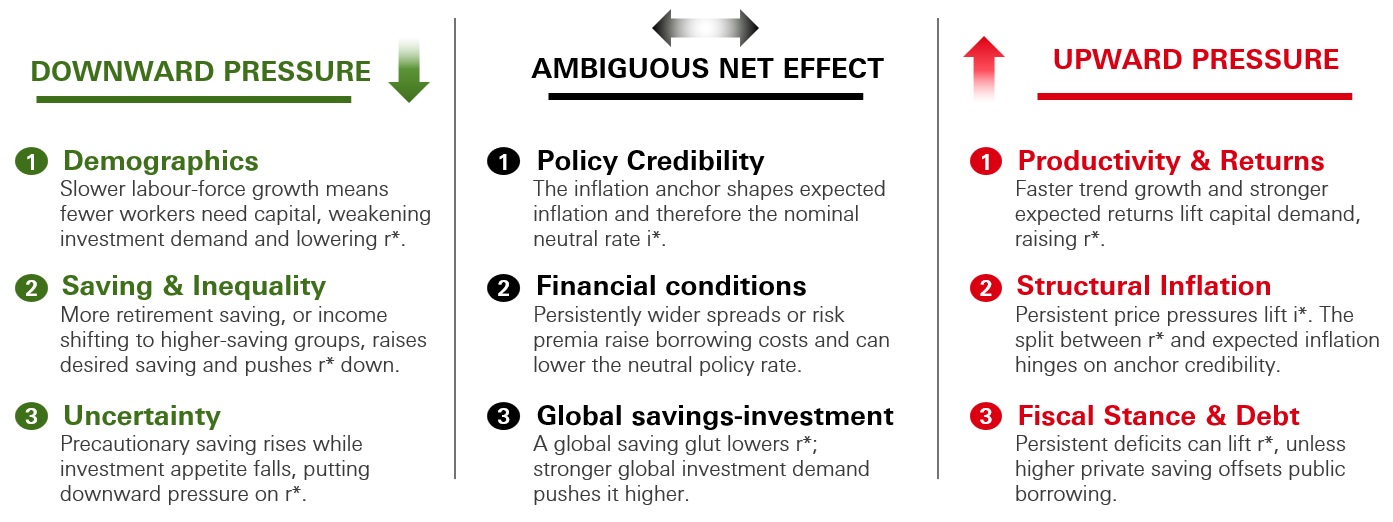
The years following the financial crisis were unusual. Weak investment demand, subdued productivity, abundant global savings and persistent disinflation allowed policy rates and long-term yields to remain exceptionally low. However, investment demand is now rising, particularly around artificial intelligence and the infrastructure required to support it. If the AI investment cycle leads to productivity improvements and companies see greater opportunities to invest, the economy can sustain a higher real rate without becoming restrictive.
Persistent government deficits also imply higher rates, especially with central banks reducing their support for bond markets. Additionally, geopolitical fragmentation and tighter labour supply can increase the real rate required to keep inflation pressures contained.
Yet the pressures do not all point the same way. Ageing populations can reduce investment demand and increase retirement saving. Large global saving pools – including China’s external surplus – can suppress equilibrium rates. AI itself could also ease upwards pressure on rates. Although the investment boom raises capital demand and could lift productivity, if technological disruption increases uncertainty around jobs and incomes, households may save more, creating an offsetting force.
Figure 1: Primary drivers of the neutral rate
Click the image to enlarge
Source: HSBC Asset Management, September 2026.
The US provides the clearest evidence that equilibrium rates have moved higher
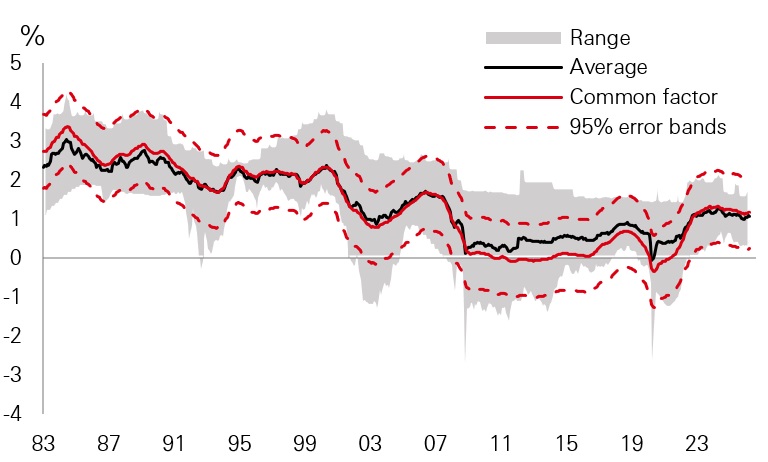
Model-based estimates suggest that the US real neutral rate has risen relative to the decade after the global financial crisis, with the current central estimate across eleven models around 1.2 per cent. Considerable uncertainty surrounds that figure. Models infer the neutral rate from economic and financial data, and their different assumptions produce a wide range of estimates. The dispersion therefore reflects meaningful differences in how the models interpret the economy.
Figure 2: Model based measures of US neutral rate
Click the image to enlarge
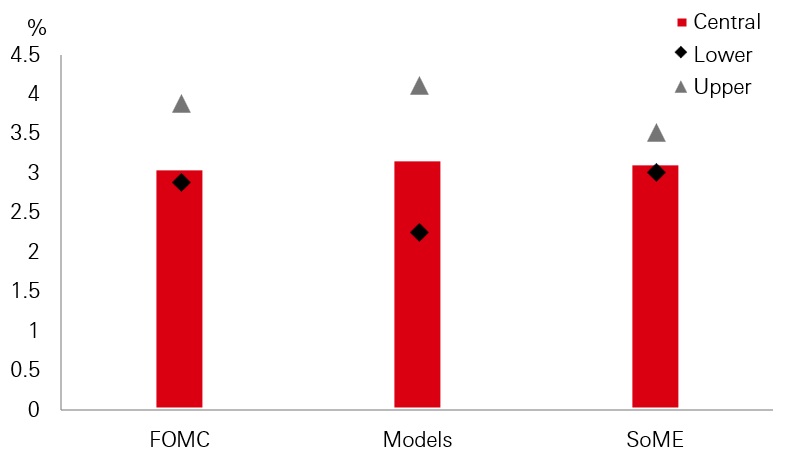
Figure 3: Estimates of the US neutral nominal policy rate (per cent)
Click the image to enlarge
Source: Oxford Economics, Federal Reserve, Federal Reserve Bank of New York, Macrobond, Models are Holston-Laubach-Williams, Lubik‑Matthes and Zaman. HSBC Asset Management, September 2026.
Measuring the Natural Rate of Interest / Lubik-Matthes Natural Rate of Interest | Richmond Fed / Neutral Interest Rates and the Monetary Policy Stance
Macro models generally tie their estimates more closely to economic fundamentals, but can respond slowly to new developments and remain sensitive to revisions to trend growth and the output gap. Financial-market models capture shifts in expectations more quickly, although risk premia and market positioning can also influence their estimates. These approaches provide complementary perspectives on the neutral rate.
Survey evidence also points to a gradual upward shift. By June 2026, the New York Fed’s Survey of Market Expectations showed a median longer-run federal funds-rate expectation of 3.1 per cent, with the middle half of responses between 3.0 per cent and 3.5 per cent. Survey responses cluster more tightly than model estimates, possibly because respondents draw on similar information and analytical frameworks. That agreement offers a useful indication of consensus, but does not necessarily imply less uncertainty about the underlying neutral rate.
Taken together, the model and survey evidence suggests a central nominal neutral-rate estimate of approximately 3.1–3.3 per cent. Our working assumption of 3.5 per cent sits moderately above that range, allowing for the upward drift in expectations and potential upside risks. The evidence supports a higher neutral rate than prevailed after the financial crisis, while leaving substantial uncertainty about its precise level.
The term premium – the compensation investors require for holding longer duration bonds rather than repeatedly investing at short maturities – explains more of the rise in yields of longer bonds
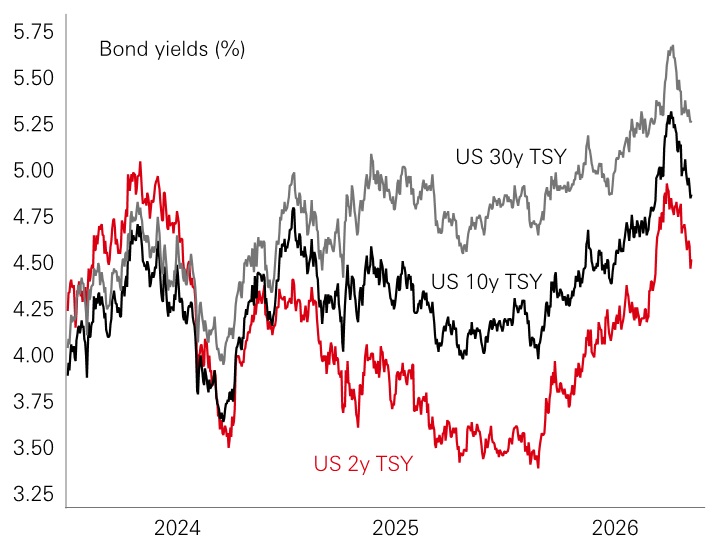
Notwithstanding the recent decline, two-year Treasury yields have risen through 2026 as markets priced in tighter policy but remain below their 2024 highs. Yet, 10- and 30-year yields are above the levels seen a few years ago. This suggests the market is demanding additional compensation for holding treasury bonds further out the curve. At the same time, the relationship between oil prices and government bond yields has strengthened, possibly reflecting concern around supply shocks.
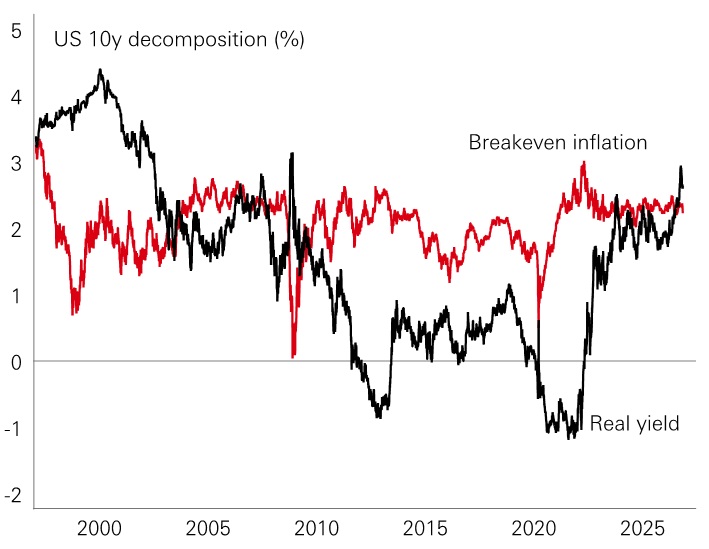
Long term inflation expectations do not appear to be the main source of the move. US breakeven inflation remains around the low-to-mid 2 per cent range, while the much larger adjustment has occurred in real yields, which have moved from deeply negative levels and are now close to those seen in the mid-2000s.
Figure 4: Short rates don’t fully explain the move
Click the image to enlarge
Figure 5: UST 10y decomposition (per cent)
Click the image to enlarge
Source: Macrobond, HSBC Asset Management, September 2026.
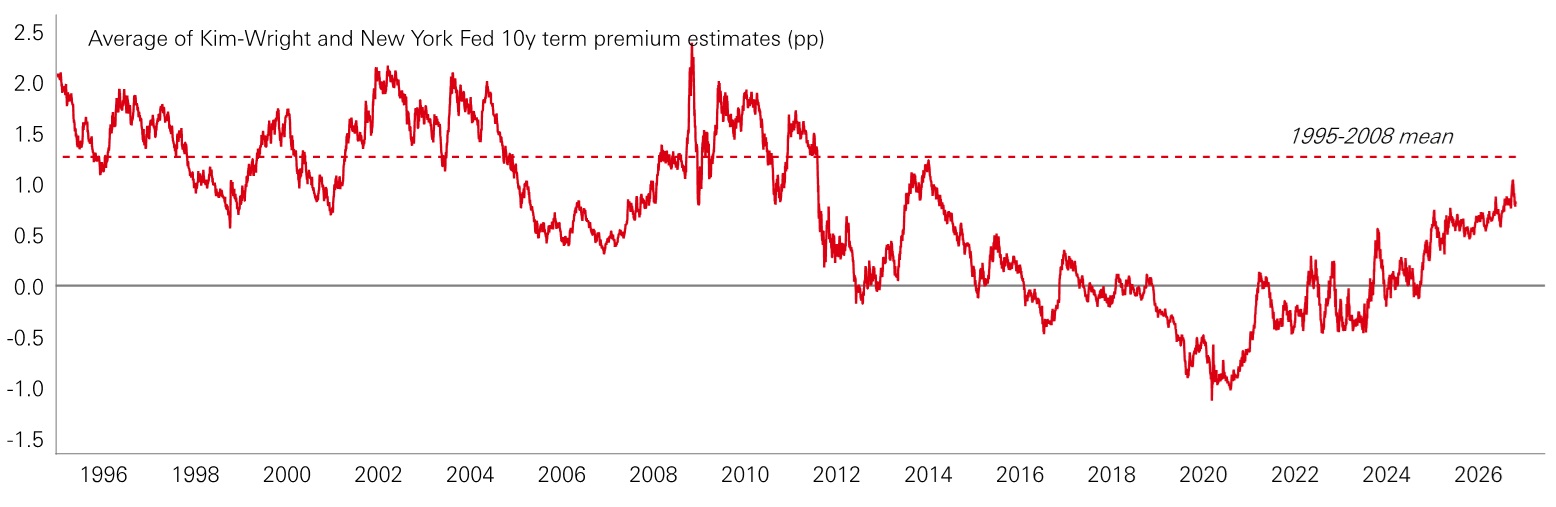
Before the global financial crisis, investors normally demanded positive compensation for taking duration risk. The US 10-year term premium averaged around 1.25 per cent. It subsequently collapsed, at times becoming negative, as quantitative easing, strong demand for safe assets and low inflation volatility suppressed the compensation investors required for duration.
Since 2021, it has rebuilt to around 0.75 per cent. Increased government issuance, declining central bank bond purchases and uncertainty around fiscal sustainability all provide reasons for that premium to remain higher than in the post crisis period.
Figure 6: Average of Kim-Wright and New York Fed 10y term premium estimates (pp)
Click the image to enlarge
Source: Macrobond, HSBC Asset Management, September 2026.
The implication might be that the post-2008 period is no longer the appropriate benchmark against which to judge yields and that investors can reassess what constitutes a “normal” long term yield.
The same argument does not apply equally across developed markets
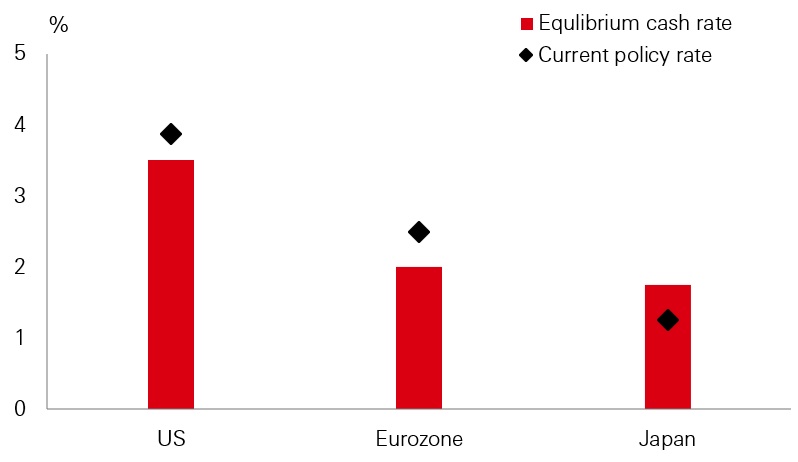
In the euro area, structural forces point to a relatively low neutral rate. Model estimates put the real equilibrium rate around zero, which translates into a nominal rate close to 2 per cent if inflation is anchored near target. Slower productivity growth, weaker demographics and lower trend rate of investment demand all help explain why the euro area equilibrium rate remains below the US.
There is nevertheless evidence of some upward drift. The economy has absorbed higher rates better than expected, bank lending remains relatively firm and recent policy discussion has increasingly acknowledged the possibility that the upper end of the neutral rate range has moved towards 2.5 per cent.
If European equilibrium rates remain structurally lower than US rates, the adjustment required in long dated European yields may ultimately be more limited.
Figure 7: Cross country policy rate comparison (per cent)
Click the image to enlarge
Source: Macrobond, HSBC Asset Management, September 2026.
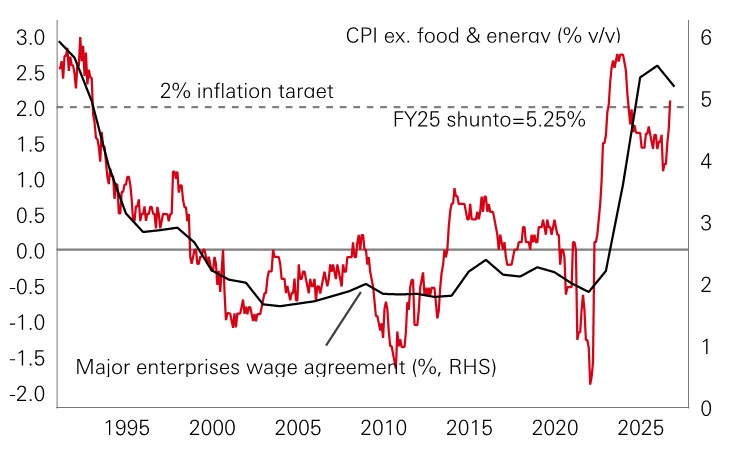
Figure 8: Japan’s wage and inflation data
Click the image to enlarge
Source: Macrobond, HSBC Asset Management, September 2026.
Japan’s real neutral rate remains close to zero in many models, reflecting ageing demographics and a long history of weak investment demand. However, an important shift is happening in nominal rates. Japan appears to be moving out of the disinflationary regime that defined much of the past three decades. Wage negotiations have produced increases above 5 per cent for three consecutive years, underlying inflation has moved higher, and companies are increasingly confident in passing costs through to prices.
The Bank of Japan is responding by moving away from an exceptionally accommodative stance. Its estimate of the nominal neutral rate range is roughly 1–2.5 per cent, while market pricing suggests policy is gradually moving towards that territory.
The challenge is that monetary normalisation is occurring alongside a more expansionary fiscal stance, which could continue to put pressure on longer dated Japanese government bond yields.
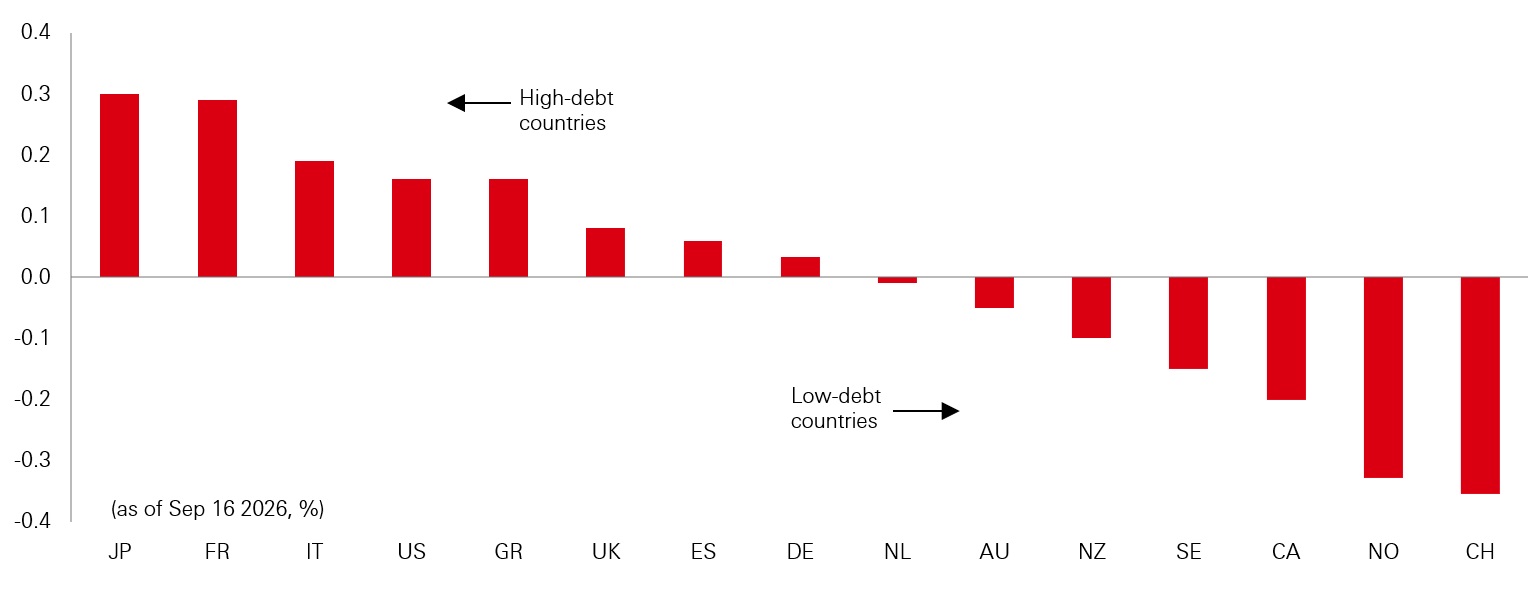
The rise in yields has become more differentiated across countries
Investors seem increasingly willing to distinguish more clearly between countries with credible consolidation plans and those where fiscal policy remains expansionary in the face of already stretched balance sheets.
Markets have generally placed greater pressure on countries where high debt burdens are combined with weaker productivity, limited fiscal flexibility or a more activist policy stance. This is particularly relevant for the UK and Japan.
Figure 9: Cumulative rise in 10yr govt bond yields above and beyond DM average
Click the image to enlarge
Source: Macrobond, HSBC Asset Management, September 2026.
In the UK, weak productivity and limited room to raise taxes or reduce spending make the fiscal arithmetic difficult, leading investors to demand greater compensation for holding long duration government bonds.
In Japan, the question is whether higher public investment can raise productive capacity sufficiently to offset the fiscal burden. If it does not, the interaction between an expansionary fiscal stance and gradually tighter monetary policy could continue to put upward pressure on long term yields.
Higher neutral rates do not automatically imply that duration should be avoided.
A higher neutral rate means the long run floor for policy rates is above the levels that prevailed after the global financial crisis. Higher real yields and a rebuilding term premium also mean long dated government bonds may require more compensation than investors had become accustomed to.
But the adjustment is not uniform. For fixed-income investors, the market outcome isn’t as overarching as proclaiming “higher yields everywhere” but instead is better viewed as “a higher and more differentiated rate regime”. Understanding what is driving yields – neutral rates, real returns, term premia or fiscal risk – should matter increasingly for assessing whether investors are being adequately compensated for taking duration risk.
Source: HSBC Asset Management, November 2026.
The views expressed above were held at the time of preparation and are subject to change without notice. Any forecast, projection or target where provided is indicative only and not guaranteed in any way. HSBC Asset Management accepts no liability for any failure to meet such forecast, projection or target.
Continue reading: Credit: Funding the AI frontier
Important information
For Professional Clients and intermediaries within countries and territories set out below; and for Institutional Investors and Financial Advisors in the US. This document should not be distributed to or relied upon by Retail clients/investors.
The value of investments and the income from them can go down as well as up and investors may not get back the amount originally invested. The performance figures contained in this document relate to past performance, which should not be seen as an indication of future returns. Future returns will depend, inter alia, on market conditions, investment manager’s skill, risk level and fees. Where overseas investments are held the rate of currency exchange may cause the value of such investments to go down as well as up. Investments in emerging markets are by their nature higher risk and potentially more volatile than those inherent in some established markets. Economies in emerging markets generally are heavily dependent upon international trade and, accordingly, have been and may continue to be affected adversely by trade barriers, exchange controls, managed adjustments in relative currency values and other protectionist measures imposed or negotiated by the countries and territories with which they trade. These economies also have been and may continue to be affected adversely by economic conditions in the countries and territories in which they trade.
The contents of this document may not be reproduced or further distributed to any person or entity, whether in whole or in part, for any purpose. All non-authorised reproduction or use of this document will be the responsibility of the user and may lead to legal proceedings. The material contained in this document is for general information purposes only and does not constitute advice or a recommendation to buy or sell investments. Some of the statements contained in this document may be considered forward looking statements which provide current expectations or forecasts of future events. Such forward looking statements are not guarantees of future performance or events and involve risks and uncertainties. Actual results may differ materially from those described in such forward-looking statements as a result of various factors. We do not undertake any obligation to update the forward-looking statements contained herein, or to update the reasons why actual results could differ from those projected in the forward-looking statements. This document has no contractual value and is not by any means intended as a solicitation, nor a recommendation for the purchase or sale of any financial instrument in any jurisdiction in which such an offer is not lawful. The views and opinions expressed herein are those of HSBC Asset Management at the time of preparation and are subject to change at any time. These views may not necessarily indicate current portfolios' composition. Individual portfolios managed by HSBC Asset Management primarily reflect individual clients' objectives, risk preferences, time horizon, and market liquidity. Foreign and emerging markets: investments in foreign markets involve risks such as currency rate fluctuations, potential differences in accounting and taxation policies, as well as possible political, economic, and market risks. These risks are heightened for investments in emerging markets which are also subject to greater illiquidity and volatility than developed foreign markets. This commentary is for information purposes only. It is a marketing communication and does not constitute investment advice or a recommendation to any reader of this content to buy or sell investments nor should it be regarded as investment research. It has not been prepared in accordance with legal requirements designed to promote the independence of investment research and is not subject to any prohibition on dealing ahead of its dissemination. This document is not contractually binding nor are we required to provide this to you by any legislative provision.
All data from HSBC Asset Management unless otherwise specified. Any third-party information has been obtained from sources we believe to be reliable, but which we have not independently verified.
HSBC Asset Management is the brand name for the asset management business of HSBC Group, which includes the investment activities that may be provided through our local regulated entities. HSBC Asset Management is a group of companies in many countries and territories throughout the world that are engaged in investment advisory and fund management activities, which are ultimately owned by HSBC Holdings Plc. (HSBC Group).
- In Australia, this document is issued by HSBC Bank Australia Limited ABN 48 006 434 162, AFSL 232595, for HSBC Global Asset Management (Hong Kong) Limited ARBN 132 834 149 and HSBC Global Asset Management (UK) Limited ARBN 633 929 718. This document is for institutional investors only and is not available for distribution to retail clients (as defined under the Corporations Act). HSBC Global Asset Management (Hong Kong) Limited and HSBC Global Asset Management (UK) Limited are exempt from the requirement to hold an Australian financial services license under the Corporations Act in respect of the financial services they provide. HSBC Global Asset Management (Hong Kong) Limited is regulated by the Securities and Futures Commission of Hong Kong under the Hong Kong laws, which differ from Australian laws. HSBC Global Asset Management (UK) Limited is regulated by the Financial Conduct Authority of the United Kingdom and, for the avoidance of doubt, includes the Financial Services Authority of the United Kingdom as it was previously known before 1 April 2013, under the laws of the United Kingdom, which differ from Australian laws;
- In Bermuda, this document is issued by HSBC Global Asset Management (Bermuda) Limited, of 37 Front Street, Hamilton, Bermuda which is licensed to conduct investment business by the Bermuda Monetary Authority;
- In France, Belgium, Netherlands, Luxembourg, Portugal, Greece, Finland, Norway, Denmark, Spain and Sweden this document is issued by HSBC Global Asset Management (France), a Portfolio Management Company authorised by the French regulatory authority AMF (no. GP99026);
- In Germany, this document is issued by HSBC Global Asset Management (Deutschland) GmbH which is regulated by BaFin (German clients) respective by the Austrian Financial Market Supervision FMA (Austrian clients);
- In Hong Kong, this document is issued by HSBC Global Asset Management (Hong Kong) Limited, which is regulated by the Securities and Futures Commission. This content has not been reviewed by the Securities and Futures Commission;
- In India, this document is issued by HSBC Asset Management (India) Pvt Ltd. which is regulated by the Securities and Exchange Board of India;
- In Italy, this document is issued by HSBC Global Asset Management (France), a Portfolio Management Company authorised by the French regulatory authority AMF (no. GP99026), through its Italian branch, regulated by Banca d’Italia and Commissione Nazionale per le Società e la Borsa (Consob);
- In Japan, this document is issued by HSBC Asset Management (Japan) Ltd (JRN 3010001124868), regulated by the Financial Services Agency;
- In Malta, this document is issued by HSBC Global Asset Management (Malta) Limited which is regulated and licensed to conduct Investment Services by the Malta Financial Services Authority under the Investment Services Act;
- In Mexico, this document is issued by HSBC Global Asset Management (Mexico), SA de CV, Sociedad Operadora de Fondos de Inversión, Grupo Financiero HSBC which is regulated by Comisión Nacional Bancaria y de Valores;
- In the United Arab Emirates, this document is issued by HSBC Investment Funds (Luxembourg) S.A. – Dubai Branch (Level 20, HSBC Tower, PO Box 66, Downtown Dubai, United Arab Emirates) regulated by the Capital Market Authority (CMA) in the UAE to conduct investment fund management, portfolios management, fund administration activities (CMA Category 2 license No.20200000336) and promotion activities (CMA Category 5 license No.20200000327).
- In the United Arab Emirates, this document is issued by HSBC Global Asset Management MENA, a unit within HSBC Bank Middle East Limited, U.A.E Branch, PO Box 66 Dubai, UAE, regulated by the Central Bank of the U.A.E. and the Capital Market Authority in the UAE under CMA license number 602004 for the purpose of this promotion and lead regulated by the Dubai Financial Services Authority. HSBC Bank Middle East Limited is a member of the HSBC Group and HSBC Global Asset Management MENA are marketing the relevant product only in a sub-distributing capacity on a principal-to-principal basis. HSBC Global Asset Management MENA may not be licensed under the laws of the recipient’s country of residence and therefore may not be subject to supervision of the local regulator in the recipient’s country of residence. One of more of the products and services of the manufacturer may not have been approved by or registered with the local regulator and the assets may be booked outside of the recipient’s country of residence.
- In Singapore, this document is issued by HSBC Global Asset Management (Singapore) Limited, which is regulated by the Monetary Authority of Singapore. The content in the document/video has not been reviewed by the Monetary Authority of Singapore;
- In Switzerland, this document is issued by HSBC Global Asset Management (Switzerland) AG. This document is intended for professional investor use only. For opting in and opting out according to FinSA, please refer to our website; if you wish to change your client categorization, please inform us. HSBC Global Asset Management (Switzerland) AG having its registered office at Gartenstrasse 26, PO Box, CH-8002 Zurich has a licence as an asset manager of collective investment schemes and as a representative of foreign collective investment schemes. Disputes regarding legal claims between the Client and HSBC Global Asset Management (Switzerland) AG can be settled by an ombudsman in mediation proceedings. HSBC Global Asset Management (Switzerland) AG is affiliated to the ombudsman FINOS having its registered address at Talstrasse 20, 8001 Zurich. There are general risks associated with financial instruments, please refer to the Swiss Banking Association (“SBA”) Brochure “Risks Involved in Trading in Financial Instruments”;
- In Taiwan, this document is issued by HSBC Global Asset Management (Taiwan) Limited which is regulated by the Financial Supervisory Commission R.O.C. (Taiwan);
- In Turkiye, this document is issued by HSBC Asset Management A.S. Turkiye (AMTU) which is regulated by Capital Markets Board of Turkiye. Any information here is not intended to distribute in any jurisdiction where AMTU does not have a right to. Any views here should not be perceived as investment advice, product/service offer and/or promise of income. Information given here might not be suitable for all investors and investors should be giving their own independent decisions. The investment information, comments and advice given herein are not part of investment advice activity. Investment advice services are provided by authorized institutions to persons and entities privately by considering their risk and return preferences, whereas the comments and advice included herein are of a general nature. Therefore, they may not fit your financial situation and risk and return preferences. For this reason, making an investment decision only by relying on the information given herein may not give rise to results that fit your expectations.
- In the UK, this document is issued by HSBC Global Asset Management (UK) Limited, which is authorised and regulated by the Financial Conduct Authority;
- In the US, this document is issued by HSBC Securities (USA) Inc., an HSBC broker dealer registered in the US with the Securities and Exchange Commission under the Securities Exchange Act of 1934. HSBC Securities (USA) Inc. is also a member of NYSE/FINRA/SIPC. HSBC Securities (USA) Inc. is not authorized by or registered with any other non-US regulatory authority. The contents of this document are confidential and may not be reproduced or further distributed to any person or entity, whether in whole or in part, for any purpose without prior written permission.
- In Chile, operations by HSBC's headquarters or other offices of this bank located abroad are not subject to Chilean inspections or regulations and are not covered by warranty of the Chilean state. Obtain information about the state guarantee to deposits at your bank or on www.cmfchile.cl;
- In Colombia, HSBC Bank USA NA has an authorized representative by the Superintendencia Financiera de Colombia (SFC) whereby its activities conform to the General Legal Financial System. SFC has not reviewed the information provided to the investor. This document is for the exclusive use of institutional investors in Colombia and is not for public distribution;
- In Costa Rica, the Fund and any other products or services referenced in this document are not registered with the Superintendencia General de Valores (“SUGEVAL”) and no regulator or government authority has reviewed this document, or the merits of the products and services referenced herein. This document is directed at and intended for institutional investors only.
- In Peru, HSBC Bank USA NA has an authorized representative by the Superintendencia de Banca y Seguros in Perú whereby its activities conform to the General Legal Financial System - Law No. 26702. Funds have not been registered before the Superintendencia del Mercado de Valores (SMV) and are being placed by means of a private offer. SMV has not reviewed the information provided to the investor. This document is for the exclusive use of institutional investors in Perú and is not for public distribution;
- In Uruguay, operations by HSBC's headquarters or other offices of this bank located abroad are not subject to Uruguayan inspections or regulations and are not covered by warranty of the Uruguayan state. Further information may be obtained about the state guarantee to deposits at your bank or on www.bcu.gub.uy.
Copyright © HSBC Global Asset Management Limited 2026. All rights reserved. No part of this publication may be reproduced, stored in a retrieval system, or transmitted, on any form or by any means, electronic, mechanical, photocopying, recording, or otherwise, without the prior written permission of HSBC Asset Management.
Content ID:D082976_v 1.0; Expiry Date: 31.05.2027


